
Tennessee TDOSHS Permit Practice Test 12
- Questions30
- Correct to pass24
- Passing score80%
- Minimum age15 years
-
1. You are joining a highway from a short ramp that has no acceleration lane. What should you do?
Show answer
Answer A: Stop or slow at the end of the ramp and wait for a safe gap
Without an acceleration lane there is no room to match speed, so you must yield at the end of the ramp and enter only when a gap allows it.
-
2. A sign on a long descent points to a RUNAWAY TRUCK RAMP a mile ahead. What is that ramp for?
Show answer
Answer C: Stopping a vehicle whose brakes have failed
An escape ramp climbs into deep gravel or sand to bring a vehicle with failed brakes to a halt, so no one should stop or park in it.
-
3. A broken white line separates your lane from the lane beside it. What does it indicate?
Show answer
Answer C: Both lanes carry traffic in the same direction and lane changes are permitted
White lines separate lanes of traffic moving in the same direction, and a broken white line means changing lanes across it is permitted when it is safe.
-
4. You are turning left at an intersection and an oncoming bicyclist is approaching in the bike lane. What must you do?
Show answer
Answer B: Yield and complete the turn only after the bicyclist has passed
A bicycle in the roadway has the same right of way as a vehicle, so a left-turning driver must yield to an oncoming rider just as to an oncoming car.
-
5. A pedestrian steps off the curb without looking your way. What should you assume?
Show answer
Answer B: That the person has not seen you at all, and be ready to stop for them
Defensive driving means assuming you have not been seen until there is clear evidence that you have.
-
6. A parking space is marked with the international symbol of access. Who may use it?
Show answer
Answer A: Only a vehicle displaying the required placard or plate
Accessible spaces may be used only by a vehicle that displays a valid disability placard or plate, no matter how short the stop would be.
-
7. You are parking facing downhill on a street with a curb. Which way should the front wheels point?
Show answer
Answer A: Toward the curb, so the vehicle would roll into it if it moved
Turning the wheels toward the curb when facing downhill means a vehicle that starts to roll is stopped by the curb instead of entering the traffic lane.
-
8. You notice that the driver ahead of you is holding a phone to the ear. What should you do?
Show answer
Answer C: Assume slower reactions and leave extra space, or else hold back
A driver on the phone reacts late and misses things, so the safe response is distance rather than a lesson.
-
9. In normal operation, which indication always comes between a green and a red on the same signal face?
Show answer
Answer C: A steady yellow
The yellow change interval must follow every green or green arrow, so a signal can never jump straight from green to red.
-
10. You are leaving a freeway on an exit ramp posted with an advisory speed of 25 mph. Where should you slow to that speed?
Show answer
Answer A: In the deceleration lane, before you reach the curve of the ramp
Slowing belongs in the deceleration lane so you arrive at the curve already at the advisory speed and do not hold up traffic still in the through lanes.
-
11. An overhead lane signal shows a flashing yellow X above your lane. What does it mean?
Show answer
Answer D: The lane may be used only for a left turn
A flashing yellow X marks a lane that may be used only to make a left turn; a steady yellow X is the one that warns you to leave the lane.
-
12. Why can an oncoming vehicle that looks comfortably far away leave you far less room than you expect?
Show answer
Answer D: You and that vehicle close the gap at the sum of both your speeds
Two vehicles approaching at 55 mph each close the distance between them at about 110 mph, so the gap disappears in half the time you would expect.
-
13. As a general rule, how far should you travel along a center two-way left-turn lane before you turn?
Show answer
Answer C: Only a short distance, just enough to slow down and wait for a gap
The center lane is for making or preparing a left turn, so you enter it only shortly before the turn and never travel along it as a through lane; several states set a specific limit such as 200 or 300 feet.
-
14. In a normal signal cycle, what comes after a steady red indication?
Show answer
Answer A: A green indication that starts the next movement
Yellow is a warning that a movement is ending, so it never precedes a green; a red is followed by a green or a green arrow.
-
15. Which stopped vehicle is protected by the Tennessee Move Over Law?
Show answer
Answer C: A utility truck working on electric, phone, gas or water service with its lights flashing
Tennessee extends the law to utility service vehicles as well as police, fire, ambulance, rescue, highway maintenance and recovery vehicles that are using flashing lights.
-
16. At roughly what speed can hydroplaning begin when a lot of water is lying on the road?
Show answer
Answer C: At speeds as low as about 35 mph
With enough water and less than perfect tread, a tire can start to ride on the water at around 35 mph, well below normal highway speeds.
-
17. Two roads come together at a shallow angle under a MERGE sign, with no yield line on either one. What is expected of you?
Show answer
Answer D: Adjust your speed and position so you blend smoothly into the other traffic
A merge means neither road ends at a stop; drivers adjust speed and position so that the two streams fit together without stopping.
-
18. The road is icy and visibility is poor, but you are driving at the posted speed limit. Is this acceptable?
Show answer
Answer A: No, because you may never drive faster than is safe for the conditions
Under the basic speed rule a driver must travel at a speed that is reasonable for the actual conditions, so a legal posted speed can still be an unlawful and unsafe speed.
-
19. At an intersection the signal flashes red toward you and flashes yellow toward the cross street. Who must yield?
Show answer
Answer D: You must, because the flashing red faces your road
A flashing red means stop and yield like a stop sign, while a flashing yellow lets the other road proceed with caution.
-
20. The inside of your windshield keeps fogging up on a cold, damp day. What clears it best?
Show answer
Answer B: The defroster with the air conditioning on, which dries the air
Fog on the inside is moisture from the cabin air. The air conditioner dries that air, and the defroster warms the glass, so together they clear it and keep it clear.
-
21. The low sun is directly ahead and glare makes it hard to see. What should you do?
Show answer
Answer C: Slow down, use the sun visor or sunglasses, and increase following distance
Sun glare can hide pedestrians, brake lights and signals. Reducing speed and adding space gives you time to react to what you cannot yet see.
-
22. Your light is green but the traffic beyond the intersection is stopped and there is no room on the far side. What should you do?
Show answer
Answer A: Wait behind the line until you can clear the far side
Entering an intersection you cannot clear blocks the cross traffic when their signal turns green, so you wait behind the line.
-
23. A blue motorist service sign showing a fuel symbol and an arrow means that
Show answer
Answer D: fuel is available in the direction shown, and the sign imposes no obligation
Service signs are informational: they tell the driver what is available and in which direction, but they create no requirement.
-
24. A reduced speed limit posted with this sign and a plaque giving hours is in force

Show answer
Answer C: during the hours shown on the plaque, or while the beacon is flashing
A school speed limit applies during the periods stated on the plaque or while the attached beacon flashes, and the regular limit governs outside those periods.
-
25. You and an oncoming driver are both turning left at the same intersection. What is the usual rule?
Show answer
Answer D: Both turn in front of each other unless markings show otherwise
The normal practice is to pass driver side to driver side, turning in front of one another, unless pavement markings or signs direct a different path.
-
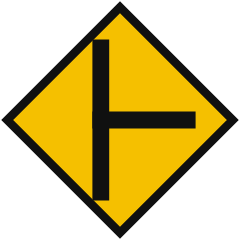
26. What condition does this sign warn a driver about?
Show answer
Answer B: Another road joins the road being traveled, from one side
It announces a side road entering the main roadway, so the driver should expect vehicles waiting to pull out and other vehicles slowing to turn in.
-
27. You are traveling beside another vehicle on a multilane highway at nearly the same speed. Why is this a poor position?
Show answer
Answer B: You may be sitting in that driver's blind spot with nowhere to go if they move over
Driving alongside removes your side escape route and often puts you where the other driver cannot see you. Speed up or drop back to open space beside you.
-
28. What is the maximum monthly lease and maintenance fee Tennessee allows an ignition interlock provider to charge?
Show answer
Answer C: 125 dollars
The monthly lease and maintenance charge for an ignition interlock device is capped at 125 dollars under state rules.
-
29. Why is it often safer to back into a parking space than to back out of one?
Show answer
Answer D: Because you leave the space going forward, with a clear view
Backing into the space puts the difficult maneuver where you are stopped and looking around, and lets you drive out facing the traffic and pedestrians.
-
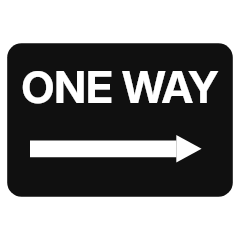
30. A driver disregards this sign and turns so as to travel against the direction it establishes. What is the immediate danger?
Show answer
Answer D: The driver will face traffic head on, because every lane comes the other way
Turning against the established direction puts the vehicle nose to nose with all the traffic on that street, which is why the mistake has to be corrected at once.