
Tennessee TDOSHS Permit Practice Test 15
- Questions30
- Correct to pass24
- Passing score80%
- Minimum age15 years
-
1. A driver reaching a stop sign is required to do what?
Show answer
Answer D: Come to a complete stop and then proceed only when it is safe
A stop sign requires a full stop before the stop line, crosswalk or intersection, after which the driver may go on once the way is clear.
-
2. How much should you normally reduce your speed on a road covered with packed snow compared with dry conditions?
Show answer
Answer C: By about half
Packed snow roughly doubles the distance needed to stop, so a common guideline is to cut speed by about half. On ice, slow to a crawl.
-
3. Why is standing water across a road dangerous even when it looks shallow?
Show answer
Answer B: It can hide a washed out roadbed, a deep hole or a missing cover
You cannot see the surface under the water, and floods commonly wash the roadbed away or lift covers off drains.
-
4. Why is following distance measured in seconds rather than in car lengths?
Show answer
Answer A: Because a time gap automatically grows with speed, while a fixed number of car lengths does not
A gap counted in seconds keeps the same margin of reaction time at any speed, whereas a fixed number of car lengths becomes far too small as speed rises.
-
5. A line of short dashes set closer together than an ordinary lane line runs beside your lane where a ramp leaves the highway. What does a dotted line of that kind convey?
Show answer
Answer A: A warning that the lane is about to change function
Dotted lines give guidance or warning about a downstream change, such as a lane that becomes an exit only lane or a lane line carried across an intersection.
-
6. Traffic is heavy and crawling where a sign warns that your lane ends and two lanes must become one. What is the best practice?
Show answer
Answer C: Use the lane to the end, then take turns merging one by one
In stop-and-go traffic the zipper merge, using both lanes up to the merge point and then alternating, keeps the queue shorter and traffic moving; in free-flowing traffic move over as soon as it is safe.
-
7. A yellow diamond reading DIP warns a driver about
Show answer
Answer A: a short, sharp depression in the road surface
A dip is an abrupt low point that can jolt a vehicle or scrape its underside, so speed should be reduced before reaching it.
-
8. You must cross a stretch of water lying across the road that you know is shallow. What is the right technique?
Show answer
Answer A: Slow down before you reach it and cross steadily in a low gear
Slow before the water, then keep a steady low speed so you do not throw water over the engine or lose steering. Test the brakes gently once you are through.
-
9. What do the grooves in a tire tread do on a flooded road surface?
Show answer
Answer B: They give the water a way to escape so the tread can touch the road
Tread grooves pump water out from under the tire so rubber can meet pavement. A worn tread moves less water, so hydroplaning starts sooner.
-
10. From which lane should a permitted U-turn be started?
Show answer
Answer A: The lane nearest the center line, the same one used for a left turn
A U-turn is begun from the far left lane for your direction, the same position used for a left turn, so you do not cut across traffic beside you.
-
11. A wide solid white line separates the through lanes from an exit lane. What does it tell drivers?
Show answer
Answer B: The choice of lane should already have been made
A channelizing line marks where the paths separate and crossing it is discouraged or prohibited, so the lane change has to happen upstream.
-
12. The lane you are in is marked with a straight arrow and a right-turn arrow together. What does that mean?
Show answer
Answer D: Drivers in that lane may either go straight or turn right
A lane marked with two arrows serves both movements, so a driver in it may take either one.
-
13. Traffic is heavy and a truck is stopped in the lane on your right. How do you keep an out?
Show answer
Answer B: Keep space open ahead of you and avoid being boxed in on both sides at once
Being hemmed in on both sides with no gap ahead removes every option, so keep at least one direction open.
-
14. You are turning left out of a driveway onto a busy two-way street. What must you do?
Show answer
Answer D: Wait for a gap in both directions before you start to move
The turn crosses one direction of traffic and joins the other, so you need a gap in both before leaving the driveway rather than stopping across a lane.
-
15. You are turning right from a one-way street onto a two-way street. Where should the turn end?
Show answer
Answer A: In the lane nearest the right curb of the street you are entering
A right turn starts and finishes as close to the right as practical, so you leave the one-way street from the right lane and arrive in the lane nearest the right curb.
-
16. What does the traffic law actually say about the right of way?
Show answer
Answer B: It says who must yield; no driver is ever entitled to take the right of way
The law describes who must yield. Right of way is something you give; insisting on it when another driver does not yield causes crashes.
-
17. What is the correct order of a pass on a two-lane road?
Show answer
Answer A: Check ahead and behind, signal left, move out, accelerate past, signal right and return
A pass begins with the decision that the road is clear and ends with a signaled return, and each step warns other drivers before the vehicle moves.
-
18. Why are motorcycles so often missed by other drivers?
Show answer
Answer C: Their narrow shape is easily hidden in traffic
A motorcycle presents a narrow outline that disappears behind pillars, mirrors and other vehicles, and it is harder to judge its speed and distance.
-
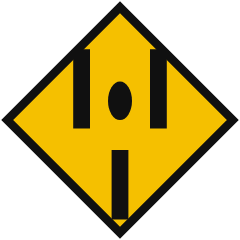
19. What must a driver be ready for beyond this sign?
Show answer
Answer C: Vehicles approaching from the opposite direction in the next lane over
The separation between the two directions runs out, so from that point oncoming vehicles share the same pavement and the driver has to keep right.
-
20. You come up behind a group of cyclists riding two abreast on a narrow rural road. What should you do?
Show answer
Answer A: Wait for a clear stretch and pass them as one group
Passing a group as a single unit when the way ahead is clear is safer than several rushed passes, and cutting through the group leaves nobody any escape room.
-
21. You stop at the curb on a busy street to let passengers out. What should you tell them?
Show answer
Answer A: To get out on the curb side, away from traffic
Passengers should always leave on the side away from moving traffic, which keeps both them and the door out of the travel lane.
-
22. Your power steering fails while you are driving. What happens and what should you do?
Show answer
Answer B: Steering becomes much harder but still works, so slow down and pull off the road
Without power assistance the steering still works, but it takes much more effort, especially at low speed. Keep both hands on the wheel and get off the road.
-
23. An emergency vehicle is stopped on the shoulder ahead with its lights flashing. What does the move over principle require?
Show answer
Answer D: Change lanes away from it, or slow down if you cannot
Move over laws ask you to give responders an empty lane, and where traffic or a two-lane road makes that impossible, you slow down instead.
-
24. You arrive at an intersection with no signs, no signals and no markings at the same time as a vehicle on the road to your right. What must you do?
Show answer
Answer B: Yield to the vehicle on your right
At an uncontrolled intersection you must yield to a vehicle already in the intersection or approaching from your right.
-
25. Two solid yellow lines are painted down the center of a two-way road. What do they mean?
Show answer
Answer B: Traffic in neither direction may cross them to pass
A double solid yellow line marks a no-passing zone that applies to traffic traveling in either direction.
-
26. On a two-lane road with a broken yellow center line, may you cross it to turn into a driveway on the left?
Show answer
Answer C: Yes, when it is safe and the oncoming lane is clear
A broken center line may be crossed for a pass or for a left turn into a road or a driveway, once the oncoming lane is clear.
-
27. Rain is heavy enough that you have your windshield wipers running. What else should you switch on?
Show answer
Answer A: Your headlights, so you can see and others can see you
Rain heavy enough to need wipers also cuts how far away you can be seen, so the headlights belong on. Many states write this into law as a wipers on, lights on rule.
-
28. You and a driver coming from the opposite direction reach a four-way stop at the same time and you are both going straight ahead. What happens next?
Show answer
Answer D: Both of you may move off together, because your paths do not cross each other
Opposing vehicles that are both going straight do not cross paths, so they can move off together once the intersection is clear.
-
29. What color scheme does a standard stop sign use?
Show answer
Answer B: White legend and border on a red background
The stop sign carries a white legend and border on a red background, the color set aside for stop, yield and prohibition messages.
-
30. A Tennessee applicant wants one credential covering both the Class D operator privilege and the Class M motorcycle privilege. What does the combined Class DM license cost?
Show answer
Answer C: 55 dollars
The combined Class DM license, covering both car and motorcycle privileges on one card, is priced at 55 dollars for the eight year term.