
Tennessee TDOSHS Permit Practice Test 23
- Questions30
- Correct to pass24
- Passing score80%
- Minimum age15 years
-
1. The car ahead of you slows down for no reason that you can see. Should you pull out and pass?
Show answer
Answer B: No, find out why it is slowing before you commit to the other lane
A driver usually slows for something, such as a turn, a hazard or a pedestrian, and that something is often exactly where your pass would take you.
-
2. How far ahead of expiration does the Tennessee Department of Safety and Homeland Security mail a courtesy renewal notice for a driver license?
Show answer
Answer A: Roughly 8 to 10 weeks before expiration
The department mails every driver a courtesy renewal notice approximately eight to ten weeks before the credential expires.
-
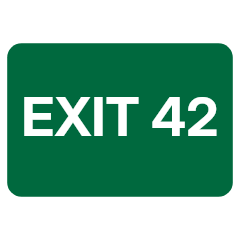
3. A driver in the left lane of a freeway realizes only when level with this sign that the ramp beside it is the one they need. What is the correct action?
Show answer
Answer A: Carry on to the next interchange and turn back from there
There is no safe way back to a ramp once it has been reached from the wrong lane, so the driver keeps going to the next interchange, where the ramps are built for that movement.
-
4. The street you are turning right onto has a bike lane along its right edge. Where should your vehicle end up?
Show answer
Answer B: In the first traffic lane to the left of the bike lane
A bike lane is not a travel lane for motor vehicles, so the nearest lane you may finish a right turn in is the first general traffic lane beside it.
-
5. How many points does Tennessee assess for passing a stopped school bus that is loading or unloading passengers?
Show answer
Answer D: 8 points
Passing a stopped school, church or youth bus taking on or discharging passengers carries 8 points, the same weight as the most extreme speeding band.
-
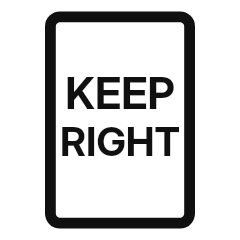
6. Where is this sign normally installed?
Show answer
Answer A: At an island or other obstruction in the roadway, to show which side traffic must take
It is placed at a divider, island or fixed obstruction so that drivers approaching it know without hesitating which side to pass on.
-
7. What is worth carrying in the vehicle during a winter trip?
Show answer
Answer A: A blanket, a flashlight, a scraper and a small shovel
A winter kit keeps you warm and visible if you are stopped for hours, and lets you clear glass and dig the wheels out. Hot water can crack cold glass.
-
8. A driver is tailgating you. Why is it a bad idea to tap or stab the brakes to warn them?
Show answer
Answer C: Because it cuts the little space they have and can cause a crash
Brake checking removes the small margin the tailgater has left and can provoke a collision; add space in front of you instead and let them pass.
-
9. Some toll facilities use signs and markings with a purple background or a purple stripe. What do they identify?
Show answer
Answer D: Lanes reserved for vehicles with an electronic toll account
Purple is assigned to lanes and ramps restricted to vehicles with a registered electronic toll collection account, so drivers without one must stay out.
-
10. A train has just cleared a crossing that carries two sets of tracks. What should you do?
Show answer
Answer B: Wait and look both ways for a second train
A passing train hides a second train on the other track, so wait until the signals stop and you can see that both tracks are clear.
-
11. Which trailer lights must work before you drive away?
Show answer
Answer B: The tail lights, brake lights and turn signals
The trailer hides the vehicle lights from anyone behind, so its own tail, brake and turn signals have to work before you move.
-
12. You see brake lights several vehicles ahead of you in your lane. What is the best first step?
Show answer
Answer C: Ease off the gas and cover the brake pedal
Reacting to the trouble several vehicles ahead, rather than waiting for the car in front, cuts your reaction time and warns the driver behind you.
-
13. A rear tire blows out on the highway. How does the vehicle usually behave?
Show answer
Answer C: The back end weaves or fishtails from side to side
A rear failure shows up as the tail wandering rather than a pull on the steering, so hold the wheel straight and let the speed drop gradually.
-
14. A driver is following you far too closely. What is the best response?
Show answer
Answer D: Increase your own following distance and let the driver pass when it is safe
More room ahead of you means you can slow gradually instead of braking hard, which reduces the chance of being struck from behind, and letting the driver by removes the problem entirely.
-
15. Your navigation device tells you to turn where a road sign says the turn is closed. What should you do?
Show answer
Answer B: Follow the signs and what you can see
A device works from stored data that can be out of date, while signs and the road in front of you show the situation now, so the road wins every time.
-
16. A signal beside a fire station stays dark until apparatus is about to leave, when it shows yellow and then red. What must a driver do?
Show answer
Answer B: Stop on the red and wait until the signal goes dark again
An emergency vehicle signal is a real traffic signal, so its red indication must be obeyed while the apparatus pulls out into the street.
-
17. In plain words, what is understeer?
Show answer
Answer B: The vehicle keeps going straight even though the wheels are turned
Understeer means the front tires have run out of grip, so the vehicle takes a wider line than the one you steered.
-
18. A yellow diamond showing the silhouette of a deer warns that
Show answer
Answer D: large animals may cross the road in that area
The sign marks a stretch where animals are known to cross, so drivers should reduce speed and scan both roadsides, especially around dawn and dusk.
-
19. Why should your thumbs rest along the rim rather than hook inside the spokes?
Show answer
Answer D: A jolt can spin the wheel and injure hooked thumbs
A pothole or a dropped wheel can snap the wheel round violently, and thumbs hooked through the spokes are trapped when it happens.
-
20. You are leaving a private driveway and entering a public street. What are you required to do?
Show answer
Answer B: Stop and yield to traffic on the street and to pedestrians on the sidewalk
A driver entering a roadway from a driveway, alley or private road must stop and yield to traffic on the roadway and to pedestrians on the sidewalk being crossed.
-
21. You are about to slow down sharply for a turn. Which check comes first?
Show answer
Answer A: A look in the mirror to see how close the traffic behind you is
Any hard slowing needs a mirror check first, because the driver behind is the one who has to react to it.
-
22. An ambulance with lights and siren is coming toward you on an undivided two-lane road. What must you do?
Show answer
Answer A: Pull to the right edge and stop until it passes
On an undivided road, drivers in both directions clear the way, pulling to the right edge and stopping.
-
23. What is the safest way to deal with a vehicle sitting in your blind spot?
Show answer
Answer A: Slow a little or move ahead so that it is no longer beside you
You cannot control the other driver, but you can change your own speed so that the vehicle is no longer hidden beside you.
-
24. You are driving at night on an unlit road using low beams. How should you choose your speed?
Show answer
Answer C: So you could stop within the distance your headlights light up
Driving faster than you can stop within the lit area is called overdriving your headlights. Anything beyond the beam is invisible until it is too late to react.
-
25. What should you do as you approach your exit from a roundabout?
Show answer
Answer A: Signal right and check the crosswalk for pedestrians before leaving
A right signal tells following drivers and waiting drivers that you are leaving, and pedestrians cross at the exit leg, so the crosswalk must be checked.
-
26. The red lights on a stopped school bus go out and the bus begins to move away. What should you do?
Show answer
Answer B: Move off slowly and keep watching for children near the road
Children who have just left the bus may still be near the roadway or crossing behind it, so pull away gently and keep looking for them.
-
27. A broken white line separates your lane from the lane on your right. What does it permit?
Show answer
Answer C: Changing lanes when it is safe to do so
A normal broken white line marks a boundary between lanes traveling the same way that road users may cross when it is safe.
-
28. A friend who has been drinking insists on driving home. What is the right thing to do?
Show answer
Answer B: Take the keys and arrange a sober ride, even if the friend objects
An impaired driver is dangerous on any street at any speed, and coffee does not lower blood alcohol. Keeping the keys and finding another way home is the only safe choice.
-
29. A disabled vehicle is blocking your lane on a two-lane road with a single solid yellow line on your side. What should you do?
Show answer
Answer C: Wait until the oncoming lane is clear, then go around carefully
The solid line prohibits overtaking a moving vehicle, but in most states a driver may go around an obstruction such as a disabled vehicle once the oncoming lane is clear and the move can be made safely.
-
30. In most states, when are headlights required apart from times of poor visibility?
Show answer
Answer A: From about half an hour after sunset to half an hour before sunrise
Most states require lights from about half an hour after sunset until about half an hour before sunrise, and some simply say sunset to sunrise; lights are also required whenever visibility is poor.