
Tennessee TDOSHS Permit Practice Test 25
- Questions30
- Correct to pass24
- Passing score80%
- Minimum age15 years
-
1. Driving at night you notice that the raised markers along the line beside you are throwing back red light. What does that tell you?
Show answer
Answer C: You are facing traffic and must get off that roadway
Red retroreflection is shown only toward traffic that should not be there, so a red return means the vehicle is heading the wrong way.
-
2. You find that the road surface has turned to sheet ice. What speed is appropriate?
Show answer
Answer A: A crawl, slow enough that you could stop without braking hard
Ice can cut grip to a fraction of normal, so stopping takes many times the usual distance and only a crawl leaves any margin.
-
3. A sign at the intersection prohibits U-turns, but the opening looks wide and clear. What may you do?
Show answer
Answer B: Obey the sign and turn around somewhere else
A prohibition applies whatever the traffic looks like at that moment, usually because of sight distance or conflicts you cannot see from the lane.
-
4. A pedestrian signal changes to a flashing upraised hand. What does that indication mean?
Show answer
Answer C: Do not start crossing, but finish a crossing already begun
The flashing upraised hand is the pedestrian change interval: nobody may start to cross, but a pedestrian already in the crosswalk may continue to the far side or to a median.
-
5. Below a speed limit sign is a smaller panel with white numbers on a black background and the word NIGHT. What does it show?
Show answer
Answer D: The limit that applies after dark
A night speed limit panel sets a separate legal maximum for the hours of darkness, and its reversed colors mark it as the night figure.
-
6. A bicyclist ahead of you puts the left arm straight out to the side. What is being signaled?
Show answer
Answer B: A left turn or a move to the left
The left arm held straight out is the bicycle signal for a left turn, so hold back and give the rider room to cross toward the center.
-
7. The only person offering you a ride home has been drinking. What should you do?
Show answer
Answer B: Do not get in; find another way home
A passenger in an impaired driver's vehicle shares all of the risk and can do nothing about it from the seat, so the only safe answer is another ride.
-
8. What does it mean to scan the road while driving?
Show answer
Answer A: Moving your eyes constantly over the road, the sides and the mirrors
Scanning keeps information coming in from every direction, while a fixed stare leaves you blind to everything else.
-
9. You are stopped in slow traffic and a motorcycle comes up between the lanes. What should you do?
Show answer
Answer D: Hold your position and avoid any sudden lane change
The danger to a rider between lanes comes from a vehicle moving sideways without warning, so staying predictable is what protects them.
-
10. A yellow lamp flashes above a warning sign at a sharp curve. What does it ask of a driver?
Show answer
Answer D: Slow down and pass the point with extra care
A warning beacon draws attention to the sign it is mounted with, and the message of the sign is what the driver must act on.
-
11. In a work zone a flagger is directing traffic in a way that conflicts with the posted signs. Whom do you follow?
Show answer
Answer B: The flagger's directions
A flagger controls traffic through a work area that changes from day to day, and those instructions take precedence over the fixed signs and markings in that zone.
-
12. Can a driver be charged with impaired driving after taking a legal over the counter medicine?
Show answer
Answer C: Yes, if the medicine impairs the ability to drive safely
Impaired driving laws cover any substance that affects driving, including cold remedies, allergy pills and sleep aids sold without a prescription.
-
13. What does Tennessee's open container statute, TCA 55-10-416, prohibit for the operator of a vehicle?
Show answer
Answer B: Possessing or consuming an open container of alcohol while operating the vehicle
The statute targets an open container that is being possessed or consumed by the operator while the vehicle is being driven, not sealed containers stored away from the driver.
-
14. An overhead lane-use control signal shows a steady red X above your lane. What does it mean?
Show answer
Answer B: You may not use that lane and must move out of it
A steady red X means the lane below it is closed to you, while a steady yellow X is the warning to prepare to vacate the lane and a downward green arrow means the lane is open.
-
15. A small plaque mounted under this sign shows a numeral such as 2 or 3. What does that numeral report?

Show answer
Answer A: How many sets of tracks the crossing carries
The plaque states the number of tracks at that location, which is a warning that a second train may be running on another track behind the first.
-
16. An overhead lane-use control signal shows a steady red X above the lane you are traveling in. What does it require?
Show answer
Answer D: Leave that lane, because it is closed to you
A steady red X means road users are not permitted to use the lane beneath it, so you must move into a lane that is open.
-
17. Why should you make sure your turn signal has stopped flashing after a lane change?
Show answer
Answer A: A signal left flashing tells other drivers that you intend to move again
Other drivers act on your signals, so one that is left on gives them false information about what you are about to do.
-
18. Travelling at about 55 mph on dry pavement, roughly how much room does an average car need to perceive, react and stop?
Show answer
Answer D: About 300 feet, close to the length of a football field
Reaction distance plus braking distance at 55 mph comes to roughly 300 feet on good dry pavement, and considerably more on a wet or loose surface.
-
19. The gates at a railroad crossing are down, and you can see that the road beyond them is clear. What is the correct action?
Show answer
Answer A: Wait until the gates rise completely and the lights go out
Lowered gates mean rail traffic is expected, and driving around them removes the only protection the crossing provides.
-
20. On what basis can Tennessee deny a Level I learner permit to a teen who is otherwise old enough to apply?
Show answer
Answer A: The teen has dropped out of school or is not making satisfactory academic progress
Tennessee ties Level I eligibility to school enrollment, so a teen who has dropped out or is not making satisfactory progress can be denied the permit.
-
21. What are front fog lights for?
Show answer
Answer D: Adding a low, wide beam close to the car when visibility is poor
Fog lights throw a low, wide beam under the fog, which is why they are mounted low and are used only in poor visibility.
-
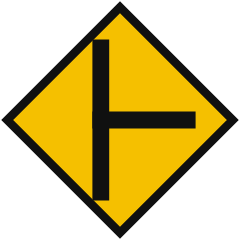
22. Approaching the point this sign refers to, which hazard is most likely?
Show answer
Answer A: A vehicle pulling out from the entering road into the driver's path
The main risk is a driver on the entering road who misjudges the gap and pulls out, so covering the brake and being ready to slow is the sensible response.
-
23. A bicyclist in the bike lane ahead of you signals and starts to move left toward the turn lane. What should you do?
Show answer
Answer A: Slow down and let the rider move across
A bicyclist who needs to leave the bike lane to turn left is changing lanes like any driver, and following traffic should make room.
-
24. Your engine stalls while you are driving in traffic. What is the correct response?
Show answer
Answer A: Shift to neutral, try to restart it, and steer and brake toward the side of the road
With the engine off, power steering and power brake assistance fade, so steering and braking take more effort but still work. Neutral lets you attempt a restart while you coast to safety.
-
25. On an overhead guide sign, the small exit number panel sits above the left-hand end rather than the right. What does that placement tell you?
Show answer
Answer A: The exit leaves from the left side of the roadway
The exit number plaque is placed on the side from which the ramp leaves, which gives advance notice of the unusual left-hand exit.
-
26. Traffic is backed up beyond a railroad crossing. When may you start across the tracks?
Show answer
Answer B: Only when there is room for your whole vehicle on the far side
Never enter a crossing you cannot clear; a vehicle stopped on the tracks in a queue has nowhere to go if the signals start.
-
27. What does a steady yellow traffic light tell the driver facing it?
Show answer
Answer A: The green movement is ending and a red indication is about to appear
A steady yellow warns that the related green movement is being terminated and that red will follow, so you should stop if you can do so safely.
-
28. You are waiting to enter a two-lane roundabout and traffic is circulating in both lanes. What must you do?
Show answer
Answer A: Yield to traffic in both circulating lanes before you enter
Every entry to a roundabout is a yield point, and at a two-lane roundabout that means giving way to vehicles in either circulating lane.
-
29. You have stopped on the shoulder of a busy freeway with a flat tire that you cannot change safely. Where should you and your passengers wait?
Show answer
Answer A: Well away from the traffic side, behind a barrier or up the bank if there is one
People struck on the shoulder are a common cause of roadside deaths, so wait away from the traffic side and behind any barrier.
-
30. What is the recommended minimum distance between the driver's breastbone and the center of the steering wheel air bag cover?
Show answer
Answer C: About 10 inches
An air bag inflates extremely fast, and keeping that much space lets it deploy fully before it reaches the driver, which is why the seat should be moved back as far as still allows comfortable control of the pedals.