
Tennessee TDOSHS Permit Practice Test 29
- Questions30
- Correct to pass24
- Passing score80%
- Minimum age15 years
-
1. How many points does Tennessee assess for driving 6 to 15 mph over the limit inside a posted work zone?
Show answer
Answer C: 4 points
Driving 6 to 15 mph over the limit in a work zone carries 4 points, matching the ordinary road penalty for the next band up, 16 to 25 mph over.
-
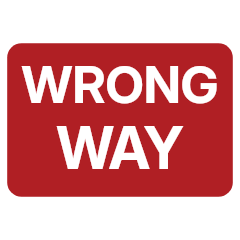
2. At a freeway exit ramp, this sign normally backs up which other regulatory sign posted nearer to the ramp terminal?
Show answer
Answer D: The sign that forbids entering that roadway at all
The two work as a pair at ramp terminals: one keeps drivers from turning in, and this one sits farther along to catch a driver who has already entered.
-
3. Your vehicle is burning at the roadside. How far away should everyone keep?
Show answer
Answer D: At least a hundred feet away from the vehicle and upwind, out of the drifting smoke
Burning vehicles give off toxic smoke and parts such as tires and struts can burst, so keep a long distance and stay upwind.
-
4. A black and white regulatory sign facing traffic at a divided section reads KEEP LEFT. What does it require?
Show answer
Answer D: Passing the island or obstruction on its left side
Keep Left is posted at an island or obstruction that traffic must pass on the left, which is the opposite of the far more common Keep Right situation.
-
5. What do zero tolerance laws mean for a driver who is under 21?
Show answer
Answer B: They commit a violation at an alcohol level far below the adult limit
Drivers under 21 may not legally drink, so every state sets a limit far below the adult one and treats even a trace reading as a violation. The exact figure is set by each state, and the penalty usually includes losing the license.
-
6. When should headlights be switched on besides during the hours of darkness?
Show answer
Answer C: Whenever rain, fog, snow or dust makes it harder to see or to be seen
Headlights are as much about being seen as about seeing, so they go on whenever visibility drops.
-
7. How does a NO OUTLET sign differ from a DEAD END sign?
Show answer
Answer B: It warns that a whole group of streets has no way out
No Outlet is posted where the road leads into a network of streets from which there is no through route, while Dead End refers to the single street itself.
-
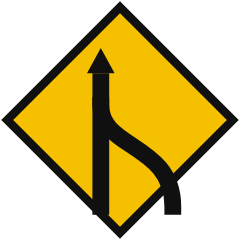
8. Why does the situation ahead of this sign deserve extra care from a motorcyclist?
Show answer
Answer C: Because a narrow machine is easy to overlook in a mirror or a blind spot
A motorcycle fills very little of a mirror and disappears easily into a blind spot, so the rider should adjust speed and lane position to stay visible where the streams come together.
-
9. A preferential lane sign reads HOV 2+ and lists the hours it applies. During those hours, which vehicles may use the lane?
Show answer
Answer A: Vehicles carrying at least two people, counting the driver
The number on an HOV sign is the minimum number of occupants, driver included, that a vehicle must carry to use the lane while the restriction is in effect.
-
10. You have printed directions or paperwork you need to check. When should you read them?
Show answer
Answer C: Before you leave, or after you park
Reading takes eyes and mind off the road for far longer than any safe glance, and a light that changes while you read leaves you moving off blind.
-
11. A truck passes you in heavy rain and its spray blanks out your windshield. What should you do?
Show answer
Answer B: Hold the wheel steady, ease off slightly and let the wipers clear it
The blackout lasts a second or two. Keeping your line and easing off is far safer than braking hard or steering blind toward the shoulder.
-
12. What must you be sure of before you pull out to pass on a two-lane road?
Show answer
Answer A: That the road ahead is clear far enough for the whole pass
You need enough clear road to pull out, pass and return before any oncoming vehicle arrives, and you must judge that distance before you start.
-
13. Why should you dim the instrument panel and keep interior lights off when driving at night?
Show answer
Answer C: Bright light inside the vehicle reduces your ability to see the dark road ahead
Your eyes adapt to the brightest light they see. A bright cabin keeps them from adjusting to the darkness outside and creates reflections on the windshield.
-
14. How many points does Tennessee assess for following another vehicle too closely, listed as following improperly?
Show answer
Answer A: 3 points
Following improperly, the schedule's term for tailgating, is worth 3 points.
-
15. You are passing a crash on the other side of a divided highway. What should you do?
Show answer
Answer D: Keep your eyes on your own lane and the traffic around you
Staring at a crash scene, often called rubbernecking, causes sudden slowing and secondary collisions. Your attention belongs on the traffic in front of you.
-
16. The circular sign shape is reserved for which warning?
Show answer
Answer C: Advance warning of a highway-rail grade crossing
A round yellow sign with a black X and the letters RR is the grade crossing advance warning sign, and the circular outline is used for no other message.
-
17. What makes a left turn protected rather than permissive?
Show answer
Answer B: Oncoming traffic is held by a red signal while you have a green arrow
A protected turn is one where the conflicting movements are stopped by their own signal, which is what the green arrow indicates.
-
18. You arrive at an intersection where the traffic signals are completely dark after a power failure. What should you do?
Show answer
Answer A: Treat the intersection as an all-way stop and take turns
When a signal is dark or out of order, drivers on every approach must stop and proceed in turn, exactly as at a four-way stop.
-
19. At a stop sign with a painted stop line and a crosswalk, where must you stop?
Show answer
Answer D: At the stop line, before it and before the crosswalk
You stop at the stop line first, and only if there is no stop line do you stop before the crosswalk, and only if there is neither do you stop before entering the intersection.
-
20. When should you arrange your way home if you plan to drink?
Show answer
Answer C: Before the first drink
Judgment is the first thing alcohol weakens, so the plan has to be made while you can still make a good one.
-
21. What do the numbers on a pedestrian countdown display show?
Show answer
Answer A: The seconds remaining to finish a crossing already under way
The countdown runs during the pedestrian change interval and shows how many seconds are left before the crossing time ends.
-
22. You are waiting in a left-turn lane at a green light when a fire engine with lights and siren comes toward you in the oncoming lanes. What should you do?
Show answer
Answer D: Hold your position and let the fire engine pass
Turning across the path of an approaching emergency vehicle is exactly what you must not do; stay put until it has gone by.
-
23. The sun is low behind you and shining into the eyes of oncoming drivers. What should you do?
Show answer
Answer C: Turn on your headlights and expect oncoming drivers not to see you
Drivers facing the low sun may not see you at all, so make yourself as visible as possible and give way rather than insisting on your right of way.
-
24. The trailer you are towing begins to sway from side to side at highway speed. What should you do?
Show answer
Answer D: Ease off the accelerator, hold the wheel steady and let the speed drop
Sway grows with speed and with sudden inputs. Reducing speed gently while keeping the steering steady lets the trailer settle behind you.
-
25. The driver ahead of you is straddling the lane line and is not signaling. How should you respond?
Show answer
Answer B: Stay back until you can see which lane that driver will take
A vehicle astride the line could move either way, so the only safe place is behind it where both possibilities are still covered.
-
26. A Tennessee driver holds a valid license but simply forgot to carry it while driving. How many points does that add to the record?
Show answer
Answer A: 2 points
Operating without the license in physical possession, despite holding a valid one, is worth 2 points, less than operating without ever being licensed.
-
27. Once you have parallel parked, how close to the curb should your wheels be?
Show answer
Answer C: Within the distance your state allows, commonly 12 to 18 inches
Parking close to and parallel with the curb keeps the vehicle out of the traffic lane without damaging the tires; each state sets the exact maximum, usually 12 inches and 18 inches in some states.
-
28. Your vehicle stalls on railroad tracks and you see a train approaching. What should you do?
Show answer
Answer D: Get everyone out and run toward the train at an angle away from the tracks
Leave the vehicle at once. Running toward the oncoming train and away from the tracks keeps you clear of the wreckage, which is thrown forward in the direction the train is moving.
-
29. As a driver keeps drinking, in what order are driving abilities usually lost?
Show answer
Answer C: Judgment, then vision, reaction time and coordination
Alcohol reaches the parts of the brain that handle judgment first, and only later does it visibly affect sight, reactions and muscle control.
-
30. A left-turn bay opens ahead of the intersection with a solid white line beside it. Where should you enter the bay?
Show answer
Answer C: At the opening before the solid line begins
The solid line marks where lane changes are no longer intended, so you move into the turn bay at its opening rather than cutting across the line later.