
Tennessee TDOSHS Permit Practice Test 34
- Questions30
- Correct to pass24
- Passing score80%
- Minimum age15 years
-
1. You realize you have just gone past your exit on a freeway. What should you do?
Show answer
Answer C: Carry on to the next exit and turn around there
A missed exit costs a few minutes, while backing up or cutting across the striped gore area puts you in the path of traffic that is not expecting it.
-
2. A sign on a divided highway reads Keep Right Except to Pass. What does it require of you?
Show answer
Answer A: Use the left lane only to overtake, then return to a lane on the right
The left lane on such a highway is reserved for overtaking, so a driver who has finished a pass must move back to the right.
-
3. A mixed drink is made with two shots of spirits. How much alcohol is that?
Show answer
Answer C: About two standard drinks
A standard drink is a fixed amount of pure alcohol, so a glass poured with two measures counts as two drinks however it is served.
-
4. An ambulance has just gone by and traffic starts to move again. Why should you wait a moment before pulling back out?
Show answer
Answer B: Another emergency vehicle may be following the first one
Emergency calls often bring several vehicles, so check that nothing else is coming before you rejoin the traffic lane.
-
5. Why is texting considered one of the most dangerous distractions?
Show answer
Answer B: It combines visual, manual and cognitive distraction at the same time
Reading or writing a message takes your eyes off the road, at least one hand off the controls and your attention off driving simultaneously.
-
6. How do stimulant drugs such as amphetamines or cocaine typically affect driving?
Show answer
Answer D: They can make the driver overconfident and more willing to take risks
Stimulants create a false sense of alertness and encourage aggressive, risky driving. When they wear off, sudden fatigue can follow.
-
7. A yellow sign reads SOFT SHOULDER. What is it telling you?
Show answer
Answer C: The shoulder may not carry the weight of a vehicle
A soft shoulder is unpaved and can let a wheel sink, so a driver who leaves the pavement there may lose control or become stuck.
-
8. A Tennessee driver leaves the scene of a crash, and the offense does not trigger a license revocation. How many points does the driving record receive?
Show answer
Answer C: 5 points
Leaving the scene of a crash without a resulting revocation is worth 5 points under the Tennessee schedule.
-
9. A sign shows a lane joining from the right with no merge required. What does that mean?
Show answer
Answer B: The joining traffic gets its own new lane, so nobody has to merge
An added lane means the roadway gains a lane at that point, so entering vehicles have somewhere to go without anyone changing lanes.
-
10. Some crosswalks are marked with two transverse lines and others with a row of wide bars laid along the direction of travel. Why is the second pattern used?
Show answer
Answer B: It is far easier for an approaching driver to see
Longitudinal bar patterns are used where extra visibility is wanted, such as an uncontrolled crossing or one near a school, because they show up much better from a car.
-
11. A snow squall cuts visibility to almost nothing while you are on a highway. What must you not do?
Show answer
Answer D: Stop in a travel lane and wait for the squall to blow through
A vehicle stopped in a lane in a whiteout is invisible until someone hits it. Slow gradually and keep moving until you can leave the roadway completely.
-
12. Two solid white lines are painted between your lane and the lane beside it. What do they mean?
Show answer
Answer D: Crossing from one lane to the other is prohibited
Double solid white lines separate lanes of traffic going the same way and may not be crossed.
-
13. How can you keep space at the sides of your vehicle in heavy traffic?
Show answer
Answer D: Drive in the gaps between the other vehicles rather than beside them
Travelling in the open spaces rather than alongside others keeps a way out open on at least one side.
-
14. Where is the safest place for children under 13 to ride?
Show answer
Answer C: In the back seat
The back seat keeps children away from the force of a deploying front air bag and is farther from the most common impact area, which is why it is recommended through at least age 12.
-
15. A rectangular red sign with the white words WRONG WAY means that
Show answer
Answer C: the driver is already traveling against the legal flow and must not continue
The wrong way sign uses a white legend and border on red and addresses a driver who has entered a ramp or one-way roadway in the wrong direction, who should stop and turn around safely.
-
16. A lane control sign over one lane shows both a straight arrow and a left arrow. What does it tell drivers in that lane?
Show answer
Answer A: Either movement may be made from that lane
An optional movement lane control sign lists every movement permitted from the lane, so a driver may choose any arrow shown.
-
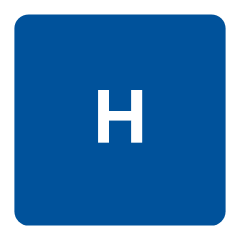
17. Which facility does this sign direct a traveler toward?
Show answer
Answer B: A hospital offering emergency care
This is the standard marker for medical care, used to lead a traveler to a hospital where emergency treatment is available.
-
18. There is a stop sign but no stop line and no crosswalk. Where must you stop?
Show answer
Answer A: Before entering the intersection, where you can see cross traffic
With no line or crosswalk, stop before you enter the intersection at the point where you can see traffic on the cross street.
-
19. Why is being predictable an important part of driving safely?
Show answer
Answer A: Because other road users are able to plan around what you are doing
Other drivers make their decisions from what they expect you to do, so surprises are what produce collisions.
-
20. At a railroad crossing with no gates and no flashing lights, the crossbuck is normally combined with which sign?
Show answer
Answer C: A yield sign, or a stop sign where an engineering study calls for one
At a passive crossing the crossbuck forms an assembly with a yield sign, or with a stop sign when an engineering study or engineering judgment supports it, so the driver knows who must give way to the train.
-
21. In a work zone one lane sits an inch or two lower than the lane beside it. How should you change lanes?
Show answer
Answer C: Slow down and cross the edge at a shallow angle, holding the wheel firmly
A vertical edge between lanes can catch a tire and jerk the steering. Crossing slowly at a shallow angle lets the wheel climb without grabbing.
-
22. The word SCHOOL is painted in large letters across the roadway. What is it doing?
Show answer
Answer D: Backing up the signs marking a school zone
Word markings on the pavement reinforce a message that is already signed, and a driver looking at the road ahead cannot miss them.
-
23. You find yourself in a lane that must turn, you wanted to go straight, and you cannot change lanes safely. What should you do?
Show answer
Answer D: Make the required turn and find another route
Going straight from a mandatory turn lane surprises everyone around you, while a wrong turn costs only a few extra minutes.
-
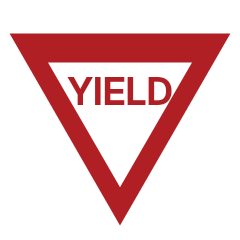
24. A driver passes this sign on an entrance ramp while merging onto a freeway. Who has priority?
Show answer
Answer B: The traffic already traveling on the freeway
The sign places the duty on the entering driver, who must adjust speed and fit into a gap without forcing through traffic to brake or swerve.
-
25. You want to move into the right lane just as an entrance ramp joins the highway at that point. What is the better choice?
Show answer
Answer B: Wait until you are past the merge area so you do not squeeze the entering traffic
The merge area is where ramp traffic has to find a gap, so adding a lane change of your own into the same space creates a conflict.
-
26. A yellow diamond showing arrows arranged in a circle warns of
Show answer
Answer B: a circular intersection such as a roundabout ahead
The circular intersection warning sign announces a roundabout or traffic circle so drivers can slow down and prepare to yield to traffic already circulating.
-
27. You reach a stretch of road covered by moving flood water of unknown depth. What is the correct decision?
Show answer
Answer D: Turn around and take another route
About a foot of moving water is enough to carry away most cars, and the roadbed under the water may already be washed out, so the only safe choice is to turn around.
-
28. You are in the right-hand lane of a multilane street and that lane becomes a right-turn-only lane ahead, but you want to go straight. What should you do?
Show answer
Answer B: Change into a through lane before you reach the markings for the turn lane
A lane-use arrow is a regulatory marking, so a driver who wants to continue straight has to leave that lane before it becomes a mandatory turn lane.
-
29. You have a green light at a school crossing, but the crossing guard steps out and holds up a stop sign toward you. What must you do?
Show answer
Answer A: Stop, because the crossing guard controls this crossing and outranks the signal
Directions from a crossing guard or a police officer take priority over signals and signs.
-
30. What is the purpose of a wide solid white line painted straight across your lane on the approach to an intersection?
Show answer
Answer C: It shows the point where a required stop must be made
A stop line indicates the point at which the stop required by a signal or a stop sign is to be made, ahead of the crosswalk and the intersection.