
Tennessee TDOSHS Permit Practice Test 43
- Questions30
- Correct to pass24
- Passing score80%
- Minimum age15 years
-
1. A vehicle in front of you has already begun turning left into a driveway when the gap you were waiting for opens up. What should you do?
Show answer
Answer B: Wait and let that driver finish the turn
A vehicle that has lawfully started a maneuver keeps the right of way until it is finished.
-
2. You are about to pull out of a driveway when someone on the sidewalk is walking toward it. What should you do?
Show answer
Answer D: Wait, because traffic on the sidewalk has the right-of-way
A vehicle entering the roadway from a driveway yields to people on the sidewalk as well as to traffic on the street.
-
3. Tennessee underage driving while impaired applies to a driver under 21 whose blood alcohol concentration reaches at least what level?
Show answer
Answer D: 0.02 percent
A driver under 21 who registers a blood alcohol concentration of 0.02 percent can be convicted of underage driving while impaired in Tennessee.
-
4. In slow summer traffic the temperature gauge climbs into the red. What should you do first?
Show answer
Answer A: Turn off the air conditioner and turn on the heater to draw heat from the engine
The heater core acts as an extra radiator, and shutting off the air conditioner reduces engine load. If the gauge keeps climbing, pull over and shut off the engine, and never open a hot radiator cap.
-
5. Where is the best place in the car for a child safety seat?
Show answer
Answer A: In the rear seat, secured either with the belt or with the lower anchors
The rear seat is furthest from most impacts and from the front airbags, and the seat must be locked in with the belt or the anchors.
-
6. A regulatory sign reads TURN ON HEADLIGHTS NEXT 15 MILES. What does it require?
Show answer
Answer C: Low beam headlights on for that stretch, day or night
Such a section is signed where a road is hard to see along, and the requirement is to run headlights, not just daytime running lamps, through the whole stretch even in bright daylight.
-
7. Where do most Tennessee residents register as organ and tissue donors?
Show answer
Answer D: At Driver Services Centers when applying for or renewing a license or ID
Nearly all Tennessee organ and tissue donor registrations happen at Driver Services Centers as part of applying for or renewing a driver license or identification card.
-
8. Why is backing up on a freeway or on its shoulder prohibited?
Show answer
Answer A: Traffic arrives far too fast to expect a vehicle moving the wrong way
Freeway traffic closes on a stopped or reversing vehicle at highway speed and has almost no time to react to something moving against the flow.
-
9. What is wrong with steering through a turn using the palm of one hand on the wheel?
Show answer
Answer D: You have less control and cannot correct quickly if something goes wrong
One-handed palming gives poor leverage and slow response. Use hand-to-hand or hand-over-hand steering with both hands so you can react instantly.
-
10. Does Tennessee's Move Over Law extend to a stopped recovery vehicle, such as a tow truck working with its lights flashing?
Show answer
Answer D: Yes, recovery vehicles like tow trucks are covered
Tennessee's Move Over Law explicitly extends to recovery vehicles, which includes tow trucks working roadside with their lights active.
-
11. Why can a motorcycle ahead of you slow down without any warning light showing?
Show answer
Answer B: The rider may slow by downshifting or rolling off
Riders often lose speed by closing the throttle or changing down, which does not switch on the brake light, so watch the machine itself and keep back.
-
12. What does this sign tell a driver about the road ahead?
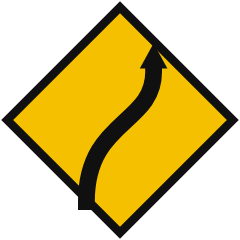
Show answer
Answer A: The roadway changes direction ahead, so speed should be reduced before reaching it
It gives advance notice of a change in alignment so the driver can slow down before entering, since braking inside a bend uses up grip that is needed for steering.
-
13. A power line has fallen across your vehicle after a crash. What should you do?
Show answer
Answer C: Stay inside and wait for utility workers unless fire forces you out
The vehicle body may be energized, and touching it and the ground at the same time can be fatal. If you must leave because of fire, jump clear with both feet together and shuffle away.
-
14. What is the safest way to pass a bicyclist on a road with two lanes going your way?
Show answer
Answer D: Change lanes completely, as you would for a car
A bicycle is entitled to the room a vehicle needs, and moving into the next lane gives the rider space to swerve around a drain or a pothole.
-
15. You stop behind another vehicle at a traffic light. How much space should you leave?
Show answer
Answer D: Enough to see where its rear tires touch the pavement
Seeing the rear tires on the road leaves room to steer around the vehicle if it stalls, and gives a cushion if you are struck from behind.
-
16. The motorcyclist ahead of you keeps moving from one side of the lane to the other. What should you understand?
Show answer
Answer B: The rider is avoiding surface hazards and staying where drivers can see the bike
Riders shift their lane position to avoid debris, grease strips and potholes and to be seen. That movement is normal and never an invitation to share the lane.
-
17. You have just passed a large truck on the freeway. Why is it dangerous to pull back in front of it and then brake for your exit?
Show answer
Answer B: A loaded truck needs much more distance to stop than a car
A fully loaded tractor-trailer can need the length of a football field or more to stop from highway speed. Cutting in and braking leaves the driver no room to avoid hitting you.
-
18. What does the implied consent law mean for drivers?
Show answer
Answer D: By driving, you have agreed to a chemical test if lawfully arrested for impaired driving
Holding a license and driving on public roads is treated as consent to breath, blood or urine testing when an officer has grounds to arrest you. Refusing normally brings its own license penalties.
-
19. It is dusk and a jogger in dark clothing is running along the edge of the road. What should you do?
Show answer
Answer D: Slow down and scan the edges of the road
Dusk is the hardest light for spotting people, and dark clothing removes most of your warning, so lower speed and a careful scan of the roadsides are the answer.
-
20. What is true about driving away from a crash you were involved in?
Show answer
Answer B: It is a serious offense, even if the other driver has driven away too
Leaving the scene is a criminal offense in every state, and the behavior of the other driver does not excuse it.
-
21. You make eye contact with a driver waiting to pull out of a side street. What should you assume?
Show answer
Answer D: The driver may still not have seen you, so stay ready to slow or stop
Drivers can look directly at you and still not register your vehicle, especially a small one. Eye contact helps, but never rely on it.
-
22. An arrow panel in a work zone shows four flashing lamps in caution mode instead of an arrow. What does that display mean?
Show answer
Answer A: Warning only, so pass the work area with caution in your current lane
Caution mode gives a general warning without directing a lane change, so drivers stay alert and pass the activity with care.
-
23. You have brought the vehicle under control after a blowout. What should you do next?
Show answer
Answer A: Signal and coast well off the road before stopping
Let the speed fall, signal, and leave the roadway as far from traffic as you can before you stop. Driving on a failed tire ruins the wheel and risks control.
-
24. Where is passing prohibited even when no line is visible?
Show answer
Answer D: On a curve or near the crest of a hill, at intersections and at railroad crossings
Passing is prohibited wherever your view of oncoming traffic is blocked or where vehicles may cross your path, which includes hills, curves, intersections and rail crossings.
-
25. Halfway through a curve you realize you are going too fast. What is the best response?
Show answer
Answer C: Ease off the gas gently and look where you want to go
Easing off transfers a little weight to the front tires without upsetting the balance, and looking through the curve keeps your steering smooth.
-
26. How must a Tennessee child who is 1 to 3 years old and weighs more than 20 pounds be secured in a vehicle?
Show answer
Answer D: In a forward-facing car seat
Once a child passes the rear-facing infant stage, Tennessee's next tier calls for a forward-facing car seat for children aged 1 to 3 who weigh more than 20 pounds.
-
27. Which vehicle is most affected by a strong side wind?
Show answer
Answer D: A van or a car towing a tall trailer
Wind pushes against the side area of a vehicle, so tall boxy shapes and trailers are moved far more than low heavy ones.
-
28. You are driving through a residential area where parked cars hide the side streets. What is the safest approach?
Show answer
Answer C: Slow down and cover the brake as you pass each opening
Where parked vehicles hide side streets and driveways, lower speed and a covered brake buy the time you lose in sight distance.
-
29. You are about to open your door after parking on the traffic side of the street. What should you do first?
Show answer
Answer C: Check the mirror and look back for approaching vehicles and bicyclists before opening the door
A door opened into traffic can strike a passing bicyclist or vehicle, so you check behind you first and keep the door open no longer than necessary.
-
30. What is a microsleep?
Show answer
Answer D: A few seconds of sleep, sometimes with the eyes open
A microsleep is an involuntary lapse of a few seconds during which the driver is asleep and the vehicle travels blind, often without the driver knowing.