
Tennessee TDOSHS Permit Practice Test 5
- Questions30
- Correct to pass24
- Passing score80%
- Minimum age15 years
-
1. In near freezing weather, which part of an otherwise clear road is most likely to still be icy?
Show answer
Answer D: A shaded dip under trees or beside a rock cut
Sun clears most of the road, but shaded hollows never warm up and can hold ice long after the rest of the pavement is dry.
-
2. Another driver takes a right of way that was legally yours. What should you do?
Show answer
Answer A: Give way to the other driver and avoid the crash, whatever the law says
Right of way is something you give, not something you take, and being in the right is no protection in a collision.
-
3. A wheel comes off your car while you are driving. What should you do?
Show answer
Answer A: Hold the wheel firmly, ease off the gas and steer gently to the shoulder
A firm grip and a gradual slowing keep the vehicle straight, while hard or sudden braking makes a damaged corner pull the car out of line.
-
4. You have just merged onto a freeway from an entrance ramp. What should you do next?
Show answer
Answer C: Settle into the right lane and build up speed before changing lanes
Crossing lanes while you are still below the speed of the traffic forces other drivers to brake, so the speed comes first and the lane change second.
-
5. A United States numbered route is normally marked with
Show answer
Answer C: black numerals on a white shield
The U.S. route marker is a white shield carrying black numerals, which sets it apart at a glance from the red, white and blue Interstate shield.
-
6. You are in the middle lane of a one-way street with three lanes when a police car approaches from behind with lights and siren. What should you do?
Show answer
Answer C: Pull to the nearest curb and stop clear of the lanes
On a one-way street you clear to whichever curb is closest, so the emergency vehicle gets a clear path down the open lanes.
-
7. Which of these places should never be used to turn your vehicle around?
Show answer
Answer C: The driveway of a fire station or the roadway in front of it
Turning around in or in front of a fire station driveway can block emergency vehicles leaving, and most states prohibit it.
-
8. A crash happens directly in front of you and vehicles are blocking both lanes. What should you do?
Show answer
Answer B: Stop at a safe distance, put on the hazards and warn the traffic behind
The greatest danger after a crash is a second collision, so stop short of it and make sure the traffic behind you can see the problem.
-
9. You are waiting in a center two-way left-turn lane. What should you expect from oncoming traffic?
Show answer
Answer A: Oncoming drivers may enter the same lane to prepare their own left turns
Both directions share a two-way left-turn lane, so an oncoming vehicle may be waiting in it and you must never treat it as yours alone.
-
10. Where is a three-point turn most clearly a bad idea?
Show answer
Answer A: On a busy street near a curve, where approaching drivers cannot see you
The maneuver leaves you blocking the road for several seconds, so it needs light traffic and a long clear view; a blind curve gives neither.
-
11. A person using a wheelchair is waiting to cross at a corner ahead. How should you treat that person?
Show answer
Answer B: As a pedestrian with the right of way at the crossing
A wheelchair or a mobility scooter user has the rights of a pedestrian, so yield the whole crossing and wait until the crossing is finished.
-
12. You are passing a tractor-trailer on a wet freeway and its wheels throw heavy spray. What is the best technique?
Show answer
Answer B: Increase your wipers and pass steadily without hesitating
Spray blinds you for as long as you stay beside the truck, so prepare the wipers first and then spend as little time in the spray as possible.
-
13. Along a highway the reference markers count upward as you travel. Where does the numbering normally begin?
Show answer
Answer C: At the southern or western edge of the state
Mileage numbering starts where the route enters the state from the south or the west, so rising numbers tell a driver which way they are heading.
-
14. What is true about an airbag once it has inflated in a crash?
Show answer
Answer B: It must be replaced by a technician before the car is driven any further
An airbag is a single use device, and the module and often the belts must be replaced before the vehicle protects anyone again.
-
15. A yellow pennant-shaped sign is posted on the left side of a two-lane road facing you. What is it telling you?
Show answer
Answer B: You are entering a no-passing zone and may not start a pass
The pennant is placed on the left so that it faces the driver who might pull out, and it marks the beginning of a no-passing zone.
-
16. A large truck ahead of you swings toward the left just before turning right at an intersection. What should you do?
Show answer
Answer B: Stay back and never try to move into the gap between the truck and the curb
Long vehicles need extra room and often swing wide to complete a right turn, so the space that opens on their right closes again as the trailer sweeps through it.
-
17. Why would a restriction like this one be applied to a stretch of road?
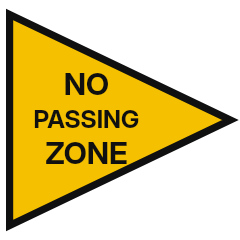
Show answer
Answer A: Because there is not enough visible road ahead to complete a pass safely
Limits on overtaking are set where a hill, a curve or an obstruction leaves too little sight distance for a driver to pull out, pass and return before meeting oncoming traffic.
-
18. You have a green light and are turning right while people are crossing the street you want to enter. Who goes first?
Show answer
Answer B: The pedestrians, and you wait until they are clear of your path
A green light permits the turn but does not remove the duty to yield to pedestrians already crossing the street you are turning into.
-
19. You come upon a crash that has just happened and decide to help. Where should you stop your vehicle?
Show answer
Answer A: Well beyond the scene, completely off the road, with the hazard lights on
Stopping past the crash and off the pavement keeps you from becoming another victim and leaves the approach clear for emergency vehicles.
-
20. Before making a right turn at an intersection, what should you check besides oncoming traffic?
Show answer
Answer B: Your right blind spot and the crosswalk, for cyclists and pedestrians
Right turns often catch a cyclist or a pedestrian coming up on the right, so check the blind spot and the crosswalk before you turn.
-
21. Why is an underinflated tire especially risky on a long drive in hot weather?
Show answer
Answer C: It flexes more, builds up heat and can fail at speed
A soft tire flexes on every rotation, and that flexing makes heat that the hot road and high speed add to until the tire can come apart.
-
22. You are about to pass a large truck on a two-lane highway. Which practice is correct?
Show answer
Answer A: Finish the pass without delay and expect wind turbulence beside the truck
Lingering beside a truck keeps you in its blind spot and exposes you to air turbulence. Pass on the left, keep moving, and move back only when you can see the whole truck in your mirror.
-
23. A yellow pennant, an isosceles triangle with its long axis horizontal, is reserved for which message?
Show answer
Answer D: No passing zone
The pennant shape is used only for the no passing zone sign, which marks the point where overtaking is no longer allowed.
-
24. You are driving in fog so thick that you can barely see the vehicle ahead. Which pavement marking is the best guide for staying in your lane?
Show answer
Answer A: The white edge line on the right side of the road
The right edge line keeps you positioned away from oncoming traffic and is easy to follow at low speed. Following tail lights closely tempts you to drive faster than you can see.
-
25. A vehicle in the lane beside you has stopped at a crosswalk. What should you do?
Show answer
Answer C: Stop as well, because that driver may be yielding to a pedestrian you cannot see
The stopped vehicle hides the crosswalk from you, and passing it is a leading cause of collisions with pedestrians who are already crossing.
-
26. The center line beside your lane is solid yellow while the opposite side has a broken yellow line. What does this mean?
Show answer
Answer D: You may not pass, but traffic in the other direction may
A solid yellow line on your side of the center marks a no-passing zone for your direction only, while the broken line grants the opposing direction a passing zone.
-
27. You feel drowsy, so you open a window and turn the radio up. What does that achieve?
Show answer
Answer B: Very little, because the drowsiness comes back
Cold air and loud music are not sleep, so the alerting effect lasts a minute or two and the driver is soon just as sleepy and closer to a lapse.
-
28. A driver extends the left arm out the window and bends it upward at the elbow. What does this signal mean?
Show answer
Answer B: A right turn
The left arm bent upward at the elbow is the standard hand signal for a right turn.
-
29. The divided highway ends warning sign means that
Show answer
Answer D: the median separating the directions ends and the road returns to two-way operation
Beyond this sign opposing traffic is no longer separated by a median, so the driver must keep right and expect vehicles approaching in the adjacent lane.
-
30. You reach an intersection showing a steady red light, and a stop line is painted across your lane. Where must you bring the vehicle to a complete stop?
Show answer
Answer C: Before the stop line
A steady red requires a complete stop before the marked stop line. Where there is no stop line you stop before the crosswalk, and where there is neither, before entering the intersection.