
Tennessee TDOSHS Motorcycle Practice Test 23
- Questions30
- Correct to pass24
- Passing score80%
- Minimum age15 years
-
1. An officer directing traffic faces you and holds one hand up with the open palm toward your vehicle. What does the gesture mean?
Show answer
Answer D: Stop before reaching the officer
A raised open palm shown toward a driver is the standard signal to stop.
-
2. Which effect appears as a drinker's blood alcohol level climbs well past the first drinks?
Show answer
Answer D: Loss of muscle control and steady steering
Higher levels of alcohol reach the parts of the brain that control movement, which shows up as clumsy steering, late braking and poor lane control.
-
3. Without a depth gauge, how can a rider tell that a tire has worn out?
Show answer
Answer A: The tread has worn down level with the wear bars set into the grooves
Wear bars are molded across the bottom of the tread grooves, and once the tread surface reaches them the tire has no usable depth left.
-
4. You are turning right off a street into a parking lot driveway that crosses a bike lane and a sidewalk. Who has the right of way?
Show answer
Answer D: Pedestrians on the sidewalk and riders in the bike lane
Turning into a driveway means crossing the paths of people who were already traveling straight, so you give way to both the bike lane and the sidewalk.
-
5. During a pre-ride check, what should the throttle do when it is released?
Show answer
Answer A: Snap back to the closed position on its own
A throttle that does not close by itself can leave the engine running fast when the rider expects it to slow, so a sticking cable must be repaired before riding.
-
6. How should braking and swerving be combined?
Show answer
Answer C: Brake before or after the swerve, never during it
Traction can be spent on turning or on braking, and asking for both at once during a swerve is very likely to cause a skid.
-
7. How should a rider use a motorcycle fitted with antilock brakes in an emergency stop?
Show answer
Answer D: Apply firm, steady pressure to both brakes and keep it there
An antilock system releases and reapplies pressure far faster than a rider can, but only while the rider keeps holding the brakes on.
-
8. What changes most when a rider moves from a light motorcycle to a much heavier one?
Show answer
Answer A: It takes longer to stop and is harder to hold up at low speed
Extra mass means longer stopping distances and more effort in slow maneuvers and when holding the machine up, so build up gradually on an unfamiliar heavy motorcycle.
-
9. The sun is low behind you and shining into the eyes of oncoming drivers. What should you do?
Show answer
Answer C: Turn on your headlights and expect oncoming drivers not to see you
Drivers facing the low sun may not see you at all, so make yourself as visible as possible and give way rather than insisting on your right of way.
-
10. A Tennessee driver is convicted of vehicular homicide. What insurance filing does the state require going forward?
Show answer
Answer D: SR-22 proof of financial responsibility
A vehicular assault, homicide or manslaughter conviction is one of the offenses that triggers the SR-22 filing requirement in Tennessee.
-
11. The car ahead drifts across the lane line and back again several times. What should you do?
Show answer
Answer C: Assume that the driver is distracted or impaired, and keep well back
Drifting is a classic sign of a distracted, drowsy or impaired driver, and distance is your protection from all three.
-
12. A small signal face beside a bikeway shows red, yellow and green lenses that each carry a bicycle symbol. Whom does it control?
Show answer
Answer C: Bicyclists using that crossing or bikeway
A bicycle signal face governs bicycle movements only, and people on foot at the same corner still follow the pedestrian signal.
-
13. A funeral procession with headlights on is crossing an intersection when your light turns green. What should you do?
Show answer
Answer A: Wait and let the whole procession go through
Most states let a funeral procession stay together once the lead vehicle has lawfully entered an intersection, and in every state you must yield to vehicles already in the intersection, so wait until the line has passed.
-
14. What does a sign reading Slower Traffic Keep Right require?
Show answer
Answer C: Traffic moving slower than the general flow must use the right-hand lane
The sign applies to any vehicle traveling below the speed of the traffic around it, which must keep right so faster vehicles can use the lanes to the left.
-
15. Which items belong to the Controls step of the T-CLOCS inspection?
Show answer
Answer D: Handlebars, levers, cables, hoses and the throttle
The Controls step covers everything the rider operates by hand or foot, plus the cables and hoses that carry those inputs to the machine.
-
16. Is it acceptable to drive far below the flow of traffic on an open highway?
Show answer
Answer B: No, driving too slowly can obstruct traffic and create a hazard
Traffic that is much slower than the surrounding flow forces other drivers into sudden braking and unnecessary passing maneuvers, and impeding traffic is itself a violation.
-
17. What protective gear should a passenger wear?
Show answer
Answer C: The same protective gear recommended for the operator
A passenger is exposed to the same crash forces, weather and road debris as the operator, so the same head, eye, hand, body and foot protection applies.
-
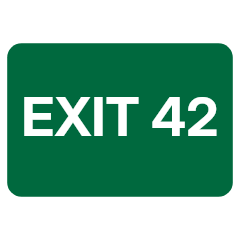
18. Where is signing of this kind normally placed along a freeway?
Show answer
Answer D: Ahead of the interchange and again at the exit, so a driver can reach the correct lane in time
Guide information for an interchange is repeated on the approach and at the ramp, because a driver who learns about the exit only at the last moment has no room left for a safe lane change.
-
19. At a stop sign with a painted stop line and a crosswalk, where must you stop?
Show answer
Answer D: At the stop line, before it and before the crosswalk
You stop at the stop line first, and only if there is no stop line do you stop before the crosswalk, and only if there is neither do you stop before entering the intersection.
-
20. A strong wind is blowing steadily across the road from your left. How should you ride?
Show answer
Answer A: Move toward the left of the lane and lean into the wind
Riding on the windward side of the lane leaves room to be pushed without leaving the lane, and a slight lean into the wind holds the line.
-
21. A yellow diamond reading DIP warns a driver about
Show answer
Answer A: a short, sharp depression in the road surface
A dip is an abrupt low point that can jolt a vehicle or scrape its underside, so speed should be reduced before reaching it.
-
22. You are behind a snow plow working on a highway. What is the correct way to drive?
Show answer
Answer C: Stay well back and do not try to pass it
A plow throws snow, runs wider than its body and works on the poor surface ahead of it, so the cleared road behind it is the safest place to be.
-
23. Which facility does this sign direct a traveler toward?

Show answer
Answer B: A hospital offering emergency care
This is the standard marker for medical care, used to lead a traveler to a hospital where emergency treatment is available.
-
24. What happens to your field of vision as your speed increases?
Show answer
Answer C: It narrows, so you notice less at the sides of the road
The faster you travel, the more your useful field of view narrows toward the center, so a hazard coming from the side is seen late or missed altogether.
-
25. What does the thick foam liner inside a certified helmet actually do in a crash?
Show answer
Answer C: It crushes so the head slows down over a longer time and distance
The crushable liner is the part that absorbs energy, letting the head decelerate gradually instead of stopping instantly against a hard surface.
-
26. After completing a turn you notice your signal is still flashing. What should you do?
Show answer
Answer A: Switch it off at once, before other drivers act on it
A signal left on after a turn is a false message, and drivers waiting to pull out may move into your path because of it.
-
27. You arrive at a four-way stop after two other vehicles have already stopped there. When is it your turn?
Show answer
Answer A: After both of the earlier vehicles have gone
Vehicles clear a four-way stop in the order they arrived, so the third driver to stop is the third to go.
-
28. A sign with a black legend on a fluorescent pink background is used for
Show answer
Answer A: traffic incident management
Fluorescent pink is set aside for signing that manages traffic around a crash, a spill or another unplanned incident, so it stands apart from routine work zone orange.
-
29. How should you position your vehicle for a right turn from a two-way street?
Show answer
Answer B: As close as practical to the right curb or edge, then turn into the nearest right lane
Right turns are made from the lane nearest the right edge into the nearest available lane, which keeps the turn tight and prevents a wide sweep into other traffic.
-
30. What identifies a helmet as certified to the federal motorcycle helmet standard?
Show answer
Answer C: A label showing DOT and the words FMVSS No. 218 CERTIFIED
Certified helmets carry a label with the DOT symbol and the wording FMVSS No. 218 CERTIFIED, together with the maker's name and the model.