
Tennessee TDOSHS Motorcycle Practice Test 29
- Questions30
- Correct to pass24
- Passing score80%
- Minimum age15 years
-
1. You want to pass on a two-lane road where several people are walking on the narrow shoulder ahead. What should you consider?
Show answer
Answer D: There is no escape room if the pass goes wrong, so wait for a better place
A pass depends on having somewhere to go if it goes wrong, and a shoulder occupied by pedestrians removes that option for both vehicles.
-
2. Which rough check suggests that a helmet is a novelty shell rather than a certified helmet?
Show answer
Answer C: It weighs about a pound, far less than a certified helmet
A certified helmet weighs roughly three pounds because of its shell and thick liner, while a novelty shell is very light. Weight is only a clue, and the certification label is the real check.
-
3. A Tennessee applicant seeking a Class M motorcycle license does not already hold a regular Class D driver license. What extra test does this trigger?
Show answer
Answer A: The applicant must also pass the Class D knowledge test
Someone applying for Class M without an existing regular license must pass the Class D knowledge test in addition to the motorcycle knowledge and skills tests.
-
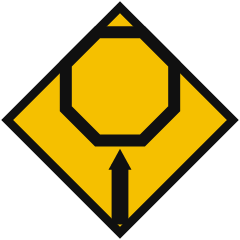
4. What is the driver expected to do after passing this sign?
Show answer
Answer A: Begin slowing so that a complete stop can be made at the intersection ahead
It is used where the control at the intersection stays hidden until late, so braking should begin here rather than at the stop line.
-
5. How many points does Tennessee assess for operating a vehicle after never having been licensed at all?
Show answer
Answer C: 3 points
Operating without ever being licensed is worth 3 points, a step above merely forgetting to carry a valid license.
-
6. You are driving on an open highway in a strong crosswind. What is the safest adjustment?
Show answer
Answer A: Reduce speed and keep a firm grip, expecting gusts on bridges and beside large vehicles
Gusts hit hardest in open gaps, on bridges and when passing high-sided vehicles, so a lower speed and a firm grip let you correct before you are pushed out of your lane.
-
7. Another driver takes a right of way that was legally yours. What should you do?
Show answer
Answer A: Give way to the other driver and avoid the crash, whatever the law says
Right of way is something you give, not something you take, and being in the right is no protection in a collision.
-
8. Besides school signing, which warning signs may also use a fluorescent yellow-green background?
Show answer
Answer C: Pedestrian and bicycle warning signs
Pedestrian crossing, bicycle and playground warning signs may use either the standard yellow or the fluorescent yellow-green background, which draws extra attention where people outside vehicles are present.
-
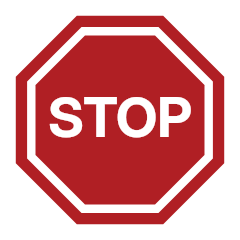
9. At an intersection where every approach carries this sign, two drivers arrive at exactly the same instant. Which of them goes first?
Show answer
Answer C: The driver on the right
Order of arrival decides who goes first, and when two vehicles arrive together the driver on the right proceeds while the other gives way.
-
10. You have just been involved in a crash on a city street. Which sequence of first steps is correct?
Show answer
Answer A: Stop where you are, check everyone for injuries, and then make the scene safe
You are required to stop, and the first priority at the scene is people, followed by preventing a second collision.
-
11. May you stop briefly across the sloped ramp that joins the sidewalk to the street at a corner?
Show answer
Answer B: No, that ramp must stay clear for people using wheelchairs
A curb ramp is the only way many people can get from the sidewalk to the crosswalk, so blocking it even briefly is prohibited.
-
12. You have a green light and an ambulance with lights and siren enters the intersection against its red. What should you do?
Show answer
Answer B: Stop and let the ambulance go through
An emergency vehicle answering a call may cross against a red, and every other driver yields to it whatever their own signal shows.
-
13. Why is smooth, early braking better than hard, late braking?
Show answer
Answer D: It keeps you in control and gives the driver behind more warning
Braking early and gently keeps the tires well within their grip and gives following drivers time to react to your brake lights.
-
14. When should speed be adjusted for a curve?
Show answer
Answer B: Before entering the curve
Slowing before the curve lets the rider hold a steady or slightly increasing throttle through it, which settles the suspension and keeps traction predictable.
-
15. A driver is following you far too closely. What is the best response?
Show answer
Answer D: Increase your own following distance and let the driver pass when it is safe
More room ahead of you means you can slow gradually instead of braking hard, which reduces the chance of being struck from behind, and letting the driver by removes the problem entirely.
-
16. How is the yield sign shaped and colored?
Show answer
Answer C: A downward-pointing triangle with a wide red border and a red legend on white
The yield sign is a downward-pointing equilateral triangle with a wide red border and the legend in red on a white background, an outline used for no other message.
-
17. How does the distance needed to stop change when a rider doubles speed?
Show answer
Answer D: It grows to roughly four times the original distance
Braking distance rises with the square of speed, so twice the speed needs roughly four times the distance in which to stop.
-
18. You have just returned to your own lane after passing. Why should you not slow down straight away?
Show answer
Answer A: The vehicle you passed is close behind and needs room to stop
Returning and then braking leaves the driver you just overtook with almost no following distance, which is how a pass turns into a rear-end collision.
-
19. A motorcycle ahead of you is weaving slightly as it crosses a stretch of grooved pavement. What should you do?
Show answer
Answer D: Give the rider extra room until the surface improves
Grooves, metal plates and loose material affect a motorcycle far more than a car, so back off and let the rider deal with the surface.
-
20. What color scheme does a standard stop sign use?
Show answer
Answer B: White legend and border on a red background
The stop sign carries a white legend and border on a red background, the color set aside for stop, yield and prohibition messages.
-
21. What should you avoid when a hostile driver pulls alongside you?
Show answer
Answer A: Making eye contact, or answering the gestures in any way at all
Any response, including a look, encourages an aggressive driver, so give none and let the vehicle go.
-
22. You have passed a large truck and want to move back into its lane. What should you see first?
Show answer
Answer B: Both of its headlights in your rear-view mirror
Seeing both headlights in your mirror means you are far enough ahead to be out of the truck's front no-zone before you move over.
-
23. Which part of the space around your vehicle can you control best?
Show answer
Answer A: The space ahead of you
You choose your own following distance, so the gap in front is the space you truly control and the one that gives you time to react.
-
24. You are riding along a street lined with parked cars. What is the safest approach?
Show answer
Answer D: Move away from the parked cars, slow down, and watch for doors and people
Doors open, drivers pull out and pedestrians step between vehicles, so extra space and a lower speed give the rider time to see and react.
-
25. You stop at a rest area because you are sleepy. How long a nap is usually recommended?
Show answer
Answer D: About fifteen to twenty minutes
A short nap of fifteen to twenty minutes restores useful alertness without leaving the grogginess a longer sleep can bring, and you should wait a few minutes before driving on.
-
26. The lights at a highway-rail grade crossing begin to flash red as you approach. What must you do?
Show answer
Answer B: Stop short of the tracks and wait until the lights stop and no train is near
Flashing red lights at a crossing require a stop clear of the tracks, and you may proceed only once the lights have stopped, any gates are fully raised and no train is approaching.
-
27. You are turning right from a one-way street onto a two-way street. Where should the turn end?
Show answer
Answer A: In the lane nearest the right curb of the street you are entering
A right turn starts and finishes as close to the right as practical, so you leave the one-way street from the right lane and arrive in the lane nearest the right curb.
-
28. How many points does an improper passing conviction add to a Tennessee driving record?
Show answer
Answer C: 4 points
Improper passing carries 4 points under the Tennessee driver improvement schedule.
-
29. What is the main risk of buying a second hand helmet?
Show answer
Answer B: You cannot know whether it has been dropped or crashed already
A helmet's protection depends on a liner that may already be crushed by an impact you cannot see, and a stranger's helmet comes with no history you can trust.
-
30. A driver who has been drinking has two cups of strong coffee. What has changed?
Show answer
Answer D: The driver is more awake but just as impaired
Coffee can make a drinker feel alert, but nothing except time removes alcohol from the blood, so a wide awake drinker is still an impaired driver.