
Tennessee TDOSHS Motorcycle Practice Test 31
- Questions30
- Correct to pass24
- Passing score80%
- Minimum age15 years
-
1. How many alcoholic drinks does it take to begin affecting driving ability?
Show answer
Answer C: Even one drink can affect it
A single drink can slow reactions and weaken judgment before you feel any change. Impairment starts long before a person feels drunk.
-
2. Where should a passenger sit on the motorcycle?
Show answer
Answer A: As far forward as possible without crowding the operator
Sitting well forward keeps the passenger weight close to the center of the motorcycle, which helps it handle closer to normal.
-
3. You find yourself in a lane that must turn, you wanted to go straight, and you cannot change lanes safely. What should you do?
Show answer
Answer D: Make the required turn and find another route
Going straight from a mandatory turn lane surprises everyone around you, while a wrong turn costs only a few extra minutes.
-
4. Your right-turn lane shows a green arrow while the through lanes face a red ball. What does that mean?
Show answer
Answer C: Only the right turn is allowed, and it is protected while the arrow lasts
A green arrow gives a protected movement in that direction only; the red ball still stops the through traffic in the other lanes.
-
5. What is the correct way to apply the front brake when you need maximum braking?
Show answer
Answer C: Squeeze it progressively harder as weight settles onto the front tire
Progressive pressure lets load build on the front tire before the braking force does, so the tire has the grip needed to handle it.
-
6. Where does the restriction that starts at this sign come to an end?
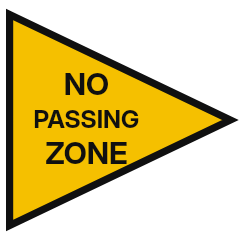
Show answer
Answer D: Where the centerline markings show that overtaking is allowed again
The sign marks the start of the restricted section, and the centerline markings along the road show how far it runs and where overtaking becomes lawful again.
-
7. A pedestrian waiting at a curb faces a steady upraised hand. What does that indication mean?
Show answer
Answer A: Do not start to cross in that direction
A steady upraised hand forbids entering the crosswalk, while a flashing hand only forbids starting a new crossing.
-
8. You are the first driver on a road just after a storm. What should you plan for?
Show answer
Answer B: Branches, mud and other debris hidden around the next bend
Storm debris lands where nobody has cleared it yet, often just beyond a curve or a crest, so reduce speed and look much further ahead.
-
9. Why should riding boots come above the ankle?
Show answer
Answer C: The ankle is easily broken and is left bare by a low shoe
The ankle takes a lot of damage when a motorcycle goes down or a foot is trapped, and a low shoe leaves it completely unprotected.
-
10. What should a rider look for in rain gear?
Show answer
Answer A: A riding rain suit that fits close and will not balloon or tear at speed
Rain gear designed for riding stays sealed and stays put in the airstream, while loose garments can flap, tear or interfere with the controls.
-
11. How many points does Tennessee assess for failing to stop at a railroad crossing when required?
Show answer
Answer D: 8 points
Failing to stop at a railroad crossing sits at the top of the schedule with 8 points, the same weight as the most serious violations listed.
-
12. What does black ice usually look like from the driver seat?
Show answer
Answer C: A patch of pavement that simply looks wet or slightly glossy
Black ice is clear, so you see the dark road through it and read it as a wet patch. In freezing weather, treat any wet looking patch as ice.
-
13. What must a Tennessee driver do to obtain a restricted license after a DUI related revocation?
Show answer
Answer B: Secure SR-22 insurance and apply at a Driver Services Center within 10 days of the court order
A DUI related restricted license requires SR-22 liability coverage, since an ordinary policy will not satisfy the requirement, and the application must be filed within 10 days of the signed court order.
-
14. In which crash must the police always be notified?
Show answer
Answer D: Any crash in which somebody has been injured or killed, whatever the damage
Injury or death always makes a crash reportable, whatever the amount of vehicle damage or the opinions of the drivers.
-
15. In a work zone a flagger signals you to stop, but the sign beside the road says the lane is open. What should you do?
Show answer
Answer C: Obey the flagger
A flagger controls the work zone in real time and the instruction outranks the signs and markings, which cannot reflect what is happening at that moment.
-
16. Should a rider change lanes while passing through an intersection?
Show answer
Answer A: No, the lane change should be completed before or after the intersection
Drivers entering and turning at an intersection are watching lanes rather than a machine moving between them, and lane markings are usually broken there.
-
17. Your road ends at a T-intersection with no signs or signals. Who has the right-of-way?
Show answer
Answer A: Traffic on the through road, and you must yield before entering
A driver on a road that ends at a T-intersection must yield to traffic on the through road that continues past the junction.
-
18. In T-CLOCS, what does the letter O stand for?
Show answer
Answer B: Oil and other fluid levels
The O step covers engine oil, along with coolant, hydraulic brake fluid and any final drive fluid, plus a look underneath for leaks.
-
19. How should a rider adjust speed on an unlit road at night?
Show answer
Answer C: Slow enough to stop within the distance the headlight actually lights up
A rider can only react to what is visible, so night speed has to fit the distance the headlight reaches rather than the posted limit.
-
20. You are clear of the tracks after your vehicle stalled on a crossing. Whom should you contact?
Show answer
Answer C: The emergency number posted on the blue sign at the crossing, or 911
Grade crossings carry an emergency notification sign with a railroad phone number and a crossing identification number so that approaching trains can be stopped, and 911 works if that sign is not visible.
-
21. How many points does Tennessee assess for failing to yield the right-of-way?
Show answer
Answer D: 4 points
Failing to yield the right-of-way is another 4 point violation on the Tennessee schedule.
-
22. Your vehicle has antilock brakes. What should you never do in an emergency stop?
Show answer
Answer A: Pump the pedal up and down
The system already releases and reapplies the brakes many times a second. Pumping the pedal interrupts it and makes the stop longer.
-
23. Along a highway the reference markers count upward as you travel. Where does the numbering normally begin?
Show answer
Answer C: At the southern or western edge of the state
Mileage numbering starts where the route enters the state from the south or the west, so rising numbers tell a driver which way they are heading.
-
24. The circular sign shape is reserved for which warning?
Show answer
Answer C: Advance warning of a highway-rail grade crossing
A round yellow sign with a black X and the letters RR is the grade crossing advance warning sign, and the circular outline is used for no other message.
-
25. A car is coming straight at you in your lane and there is no time for it to move back. What should you do?
Show answer
Answer A: Brake, sound the horn and steer to the right, toward the shoulder or ditch
Steering right takes you away from the other vehicle even if its driver corrects course, and the shoulder or ditch is survivable.
-
26. Another driver is behaving aggressively toward you. What should you do?
Show answer
Answer D: Avoid eye contact, give them room to go on their way and do not respond to provocation
Responding to an aggressive driver escalates the conflict, while creating distance and refusing to engage takes you out of the situation. Report serious threats once you can do so safely.
-
27. Which Tennessee credential covers a motor driven cycle or scooter in the 51 to 125 cubic centimeter range for a rider who is 16 or older?
Show answer
Answer A: Class M-Limited, issued without any age or engine restriction beyond the range itself
Tennessee's Class M-Limited license is the credential for a motor driven cycle between 51 and 125 cc, issued to riders 16 and older without the additional restrictions that apply to 15 year olds.
-
28. Partway through a tight turn in a parking area you realize the motorcycle will not come around in the space available. What is the safest thing to do?
Show answer
Answer C: Stop, put a foot down and reposition the motorcycle before trying again
At very low speed there is no cost to stopping and starting the turn over, while forcing a turn the space does not allow simply drops the machine.
-
29. Where is a U-turn generally the most reasonable choice?
Show answer
Answer B: At an intersection where it is permitted and you can see well both ways
A U-turn needs a legal place and a long clear view in both directions, which is why a permitted intersection with open sight lines is the usual choice.
-
30. On a narrow residential street, why does parking tight against the curb matter so much?
Show answer
Answer C: Because fire trucks and ambulances need the width to get through
Cars parked even a foot out from the curb on both sides can narrow a street until a fire truck or ambulance cannot pass.