
Tennessee TDOSHS Motorcycle Practice Test 33
- Questions30
- Correct to pass24
- Passing score80%
- Minimum age15 years
-
1. A turn restriction sign at the corner shows a range of times below the symbol. What does that mean?
Show answer
Answer A: The turn is banned only during the hours shown on the sign
Times posted under a regulatory symbol set the period during which the restriction applies; outside those hours the movement is permitted.
-
2. Why do watering eyes matter so much to a rider?
Show answer
Answer D: Blurred vision delays the moment you see and react to a hazard
Wind makes unprotected eyes water, and even a brief loss of clear vision at road speed costs you the distance you need to react.
-
3. Well before an intersection, an overhead sign shows a diagram of the lanes with an arrow above each one. What is its purpose?
Show answer
Answer C: To let drivers pick the correct lane in good time
Advance intersection lane control signs display the lane assignment far enough back that drivers can move over calmly instead of at the last moment.
-
4. You are circulating in the inner lane of a two-lane roundabout, your exit is next, and a vehicle is beside you in the outer lane. What should you do?
Show answer
Answer C: Keep circulating around the island and take that same exit on your next time around
You may not cut across a vehicle in the outer lane; if you cannot exit safely, continue around the circle and try again.
-
5. A rider notices scalloped, uneven wear across the front tire. What does that suggest?
Show answer
Answer C: A suspension or wheel bearing fault that should be inspected
Cupped or scalloped wear normally points to worn fork components or loose wheel bearings letting the tire bounce as it rolls.
-
6. A barricade carries a sign reading ROAD CLOSED TO THROUGH TRAFFIC. What does it permit?
Show answer
Answer B: Local access for people whose destination is on that road
This closure keeps out drivers who are only passing through while still allowing residents and deliveries to reach addresses within the closed section.
-
7. Which warning sign keeps its yellow background even when it is used inside a work zone?
Show answer
Answer D: The grade crossing advance warning sign
The round grade crossing advance warning sign keeps its black legend on yellow inside temporary traffic control zones because the railroad hazard it describes is not temporary.
-
8. Once you are moving, which way of using a navigation device costs you the least attention?
Show answer
Answer B: Listening to the spoken directions
Voice guidance lets you keep your eyes on the road, while anything that needs the screen takes glances that add up over a trip.
-
9. The light ahead is green, but traffic beyond the intersection is backed up so far that you could not clear it. What is the correct action?
Show answer
Answer D: Wait behind the stop line until there is room on the far side
Entering an intersection you cannot clear blocks cross traffic and pedestrians, so you should hold your position until space opens on the other side.
-
10. Why should reflective material be placed on the front, back and sides of a rider's gear?
Show answer
Answer D: A driver may approach the rider from any of those directions
Threats come from ahead, behind and from the sides at intersections, so reflective material should be visible from every direction a vehicle can approach.
-
11. What should a rider remember about convex mirrors?
Show answer
Answer B: They show a wider view, but vehicles look farther away and slower than they are
The curved glass fits more of the scene into the mirror, and the price of that extra width is a distorted sense of distance and closing speed.
-
12. A large electronic advertising sign beside the road catches your eye. What should you do?
Show answer
Answer A: Glance briefly and return your eyes to the road
Bright changing displays are designed to hold attention, so treat them like any roadside object and give them no more than a brief glance.
-
13. What kind of sole and heel suit motorcycle boots?
Show answer
Answer A: A hard, slip resistant sole with a low heel that will not catch
Boots have to grip the pavement when you put a foot down and grip the footrests while you ride, and a tall heel can catch on the ground or on the machine.
-
14. A driver waiting to turn left appears to be looking straight at you. What should you assume?
Show answer
Answer C: That the driver may still not have seen you, and may turn across your path
Drivers look toward motorcycles without registering them, so eye contact is not evidence that the rider has been seen and no plan should depend on it.
-
15. A traffic light ahead of the group turns yellow as the leader approaches it. What should the leader do?
Show answer
Answer C: Stop normally and let the group be split by the signal
Keeping the group together never outranks obeying the signal, and the riders left behind simply catch up at the next stop.
-
16. The curb ahead is signed as a bus stop. May you wait there with your vehicle?
Show answer
Answer C: No, the space must stay clear for buses
A bus stop must stay open so that a bus can reach the curb and let passengers on and off safely, so no other vehicle may occupy it.
-
17. You are the first to arrive at a crash on a rural road. What should you do first?
Show answer
Answer C: Park well clear of the scene, put on your hazard lights and call for help
Getting trained help on the way and keeping the scene visible does more good than anything an untrained bystander can do.
-
18. You are parked legally, but a police officer tells you to move the vehicle. What should you do?
Show answer
Answer B: Move it as directed, because an officer overrides the signs
Directions from a police officer or a firefighter take precedence over signs and markings, whether they are directing traffic or clearing a street.
-
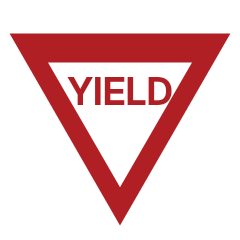
19. Apart from other vehicles, who else must a driver let go first at this sign?
Show answer
Answer A: Pedestrians and cyclists already in or entering the crossing
The duty to give way covers every road user who has the right of way at that point, including people walking or cycling across the driver's path.
-
20. While you are still on an entrance ramp, where should your attention be?
Show answer
Answer D: Along the ramp ahead and back at the highway traffic in the mirrors and over your shoulder
A merge needs both halves of the picture at once: the ramp curving ahead of you and the traffic you are about to join behind and to your left.
-
21. Why does a passenger often feel the cold sooner than the rider on a long ride?
Show answer
Answer B: A passenger sits still and does not have the fuel tank to shelter behind
The rider has a screen or a tank to break the wind and is busy operating the machine, while a passenger sits exposed and inactive and chills faster.
-
22. What should the operator do while a passenger climbs on board?
Show answer
Answer D: Sit on the machine with both feet planted and the front brake held on
The added weight arrives suddenly and off center, so the operator braces the motorcycle with both feet down and the front brake applied to keep it still.
-
23. You have had to leave the pavement onto a loose gravel shoulder and now need to stop. How should you brake?
Show answer
Answer D: Use both brakes gently and evenly, expecting a much longer stopping distance
Loose gravel cuts available traction sharply, so apply both brakes lightly and smoothly and allow far more room than you would need on pavement.
-
24. A ball rolls into the street from between parked cars ahead of you. What should you expect and do?
Show answer
Answer A: Expect a child to follow it and be ready to stop
A ball is usually followed by a child who is watching the ball and not the traffic. Slow down and be prepared to stop immediately.
-
25. You have stopped on the shoulder of a highway and want to rejoin the traffic. What is the correct way?
Show answer
Answer D: Signal, build up speed along the shoulder, then merge into a gap
Entering a fast lane at a slow speed is what causes the conflict, so the shoulder is used to gain speed before the merge in the same way as an acceleration lane.
-
26. You are riding a shaded back road in autumn and reach a mat of wet leaves covering the pavement. What should you expect?
Show answer
Answer D: Traction can be nearly as poor as ice, so slow down before you reach them
Wet leaves are slick and they hide whatever is underneath, so reduce speed before the patch and cross it upright without braking or turning.
-
27. Where are children in the greatest danger around a school bus?
Show answer
Answer B: In the roadway right around the bus, especially in front
The danger zone is the band of roadway around the bus where the driver's view is poorest, and children crossing in front of the bus are hardest to see.
-
28. You notice a bulge on the sidewall of one of your tires. What should you do?
Show answer
Answer D: Have the tire replaced before driving far, because it could blow out
A sidewall bulge means the internal cords have broken and only the rubber is holding the air. The tire can fail suddenly at any speed.
-
29. What is the correct order of a pass on a two-lane road?
Show answer
Answer A: Check ahead and behind, signal left, move out, accelerate past, signal right and return
A pass begins with the decision that the road is clear and ends with a signaled return, and each step warns other drivers before the vehicle moves.
-
30. You find that the road surface has turned to sheet ice. What speed is appropriate?
Show answer
Answer A: A crawl, slow enough that you could stop without braking hard
Ice can cut grip to a fraction of normal, so stopping takes many times the usual distance and only a crawl leaves any margin.