
Tennessee TDOSHS Motorcycle Practice Test 38
- Questions30
- Correct to pass24
- Passing score80%
- Minimum age15 years
-
1. Warning signs such as stop ahead, yield ahead and signal ahead are installed mainly where
Show answer
Answer B: the traffic control device cannot be seen from far enough away
These advance warning signs are used when a crest, curve or obstruction keeps the stop sign, yield sign or signal from coming into view in time for a driver to react.
-
2. How should a load be distributed between the two saddlebags?
Show answer
Answer B: Evenly, so the weight is balanced from side to side
An uneven load pulls the motorcycle toward the heavy side and makes it behave differently in left turns than in right turns.
-
3. You are riding on a multi-lane road with a car traveling beside you in the lane on your right. Which lane position is usually best?
Show answer
Answer D: The left portion, so you keep a cushion of space from the car alongside
Lane position is chosen to hold space between the motorcycle and the nearest hazard, and here that hazard is the vehicle on the right.
-
4. You cannot avoid an obstacle lying in the road. At what angle should you try to cross it?
Show answer
Answer D: As close to 90 degrees as possible
Meeting the obstacle squarely keeps the front wheel from being deflected sideways as it climbs over the edge.
-
5. What penalties does Tennessee attach to an underage driving while impaired conviction?
Show answer
Answer C: Loss of the license for one year and a 250 dollar fine
The conviction costs the young driver the license for one year plus a 250 dollar fine, and public service work is sometimes added.
-
6. You are ready to pull out of a parallel parking space into the traffic lane. What should you do?
Show answer
Answer C: Signal, check the mirror and blind spot, and wait for a gap
A driver leaving a parking space must yield to traffic already in the lane, so signal, look for the gap and only then move out.
-
7. In a tight, slow speed turn such as a parking lot U-turn, the rider should:
Show answer
Answer C: Lean the motorcycle while keeping the body upright
Keeping the body upright while the motorcycle leans lets the machine turn tightly and helps the rider hold balance at very low speed.
-
8. You are turning right onto a one-way street. Which lane of that street should you enter?
Show answer
Answer C: The lane closest to the right curb
Even though every lane on a one-way street runs your way, a right turn must end in the lane nearest the right curb; you may change lanes afterwards when it is safe.
-
9. Which clue tells you that a parked vehicle is about to pull into traffic?
Show answer
Answer D: Exhaust smoke, brake lights, front wheels turned out or a driver in the seat
A running engine, lit brake lights, turned wheels or a person behind the wheel all mean the vehicle may move. Slow down and give it room.
-
10. On loose gravel or deep fresh snow, how does an antilock system affect the stopping distance?
Show answer
Answer D: It can lengthen it, although you keep the ability to steer
On loose surfaces a locked wheel piles up a wedge of gravel or snow that helps it stop, so the antilock stop can be longer even though steering still works.
-
11. Just before the front wheel reaches an obstacle, what should you do with the throttle?
Show answer
Answer C: Roll it on slightly to lighten the front end
A small amount of throttle shifts weight rearward and lightens the front wheel so it rides over the obstacle more easily.
-
12. A Tennessee driver's SR-22 policy is cancelled before the requirement is finished. What happens next?
Show answer
Answer D: The driver's driving privileges are suspended, and the SR-22 and reinstatement fees must be redone
An early lapse in SR-22 coverage leads to a suspension for failing to maintain proof of financial responsibility, forcing the driver to refile SR-22 and pay reinstatement fees.
-
13. Once the motorcycle is leaned over and settled in a curve, what should the throttle be doing?
Show answer
Answer C: Held steady or rolled on gently through the curve
A steady or slightly increasing throttle keeps the suspension settled and the weight balanced, while closing it mid-curve unloads the rear tire.
-
14. You are approaching a refuse collection truck working along your street. What should you expect?
Show answer
Answer D: Workers stepping into the road around the truck
Collection crews move constantly between the truck and the curb, often from where you cannot see them, so slow right down and pass only when the whole area is clear.
-
15. You pass into a work zone with a reduced speed limit but you see no workers. What speed applies?
Show answer
Answer D: The posted work zone limit, whether or not workers are present
A posted work zone speed limit is a regulatory limit in force at all times, and narrow lanes and uneven surfaces remain dangerous when nobody is working.
-
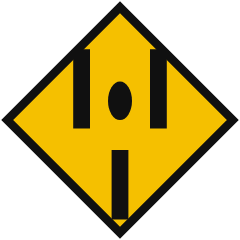
16. What should a driver do first after passing this sign?
Show answer
Answer A: Move into the right-hand lane and stay there
Traffic returns to two-way operation, so the driver keeps to the right of the centerline and stops treating the left side as available.
-
17. How should a rider approach a curve whose radius keeps tightening the further you go into it?
Show answer
Answer A: Enter more slowly than the curve first appears to need, saving lean for the exit
In a decreasing radius curve the sharpest part comes last, so a slower entry leaves both speed and lean angle in reserve for where they are needed.
-
18. You notice at night that one of your headlights has burned out. What should you do?
Show answer
Answer B: Get it replaced promptly, because other drivers may take you for a motorcycle
A single light makes your vehicle look narrower and further away, so other drivers misjudge you, and one light is also illegal.
-
19. You are driving in fog so thick that you can barely see the vehicle ahead. Which pavement marking is the best guide for staying in your lane?
Show answer
Answer A: The white edge line on the right side of the road
The right edge line keeps you positioned away from oncoming traffic and is easy to follow at low speed. Following tail lights closely tempts you to drive faster than you can see.
-
20. You receive a phone call that you feel you must answer while driving. What is the safest way to take it?
Show answer
Answer D: Pull off the road, stop in a safe place and then answer
No call is worth a crash. Stopping in a safe location removes the distraction completely, while every other option divides your attention.
-
21. You see brake lights several vehicles ahead of you in your lane. What is the best first step?
Show answer
Answer C: Ease off the gas and cover the brake pedal
Reacting to the trouble several vehicles ahead, rather than waiting for the car in front, cuts your reaction time and warns the driver behind you.
-
22. You have stopped on an uphill grade close behind a large truck at a traffic signal. What is the risk?
Show answer
Answer B: The truck may roll back into you when it starts to move
Heavy vehicles can roll backward a short distance when the driver moves from the brake to the accelerator on a hill. Leave extra room when stopped behind a truck on a grade.
-
23. Why is parking too close to a street corner prohibited?
Show answer
Answer D: Because it hides approaching traffic and pedestrians
A vehicle parked at a corner blocks the view that both drivers and pedestrians need before entering the intersection.
-
24. How many points does Tennessee assess for driving 6 to 15 mph over the limit inside a posted work zone?
Show answer
Answer C: 4 points
Driving 6 to 15 mph over the limit in a work zone carries 4 points, matching the ordinary road penalty for the next band up, 16 to 25 mph over.
-
25. Loose gravel has been swept into the middle of your lane on a downhill bend. Which controls are affected most?
Show answer
Answer D: Steering and braking, since the loose stones roll under the tires
Gravel rolls between rubber and pavement, so the tires can neither turn the vehicle nor slow it as they would on a clean surface.
-
26. How should you follow a school bus in traffic?
Show answer
Answer A: Far enough back to see its lights and stop in time
A school bus stops often and with little warning, so a longer following distance gives you time to see the lights come on and stop clear of it.
-
27. Why is a U-turn on a one-way street a problem?
Show answer
Answer A: You would end up facing the wrong way against all the traffic
Every lane of a one-way street runs the same way, so turning around leaves you driving head-on against all of the traffic.
-
28. What is a microsleep?
Show answer
Answer D: A few seconds of sleep, sometimes with the eyes open
A microsleep is an involuntary lapse of a few seconds during which the driver is asleep and the vehicle travels blind, often without the driver knowing.
-
29. Federal law lets a state open its high-occupancy vehicle lanes to certain vehicles carrying only one person. Which of these is covered by that allowance?
Show answer
Answer B: Motorcycles
Federal law lets states allow motorcycles into high-occupancy vehicle lanes regardless of the number of occupants, because keeping riders in the flow is safer than the alternative.
-
30. You arrive at an intersection where the traffic signals are completely dark after a power failure. What should you do?
Show answer
Answer A: Treat the intersection as an all-way stop and take turns
When a signal is dark or out of order, drivers on every approach must stop and proceed in turn, exactly as at a four-way stop.