
Tennessee TDOSHS Motorcycle Practice Test 46
- Questions30
- Correct to pass24
- Passing score80%
- Minimum age15 years
-
1. How far ahead should you normally be looking as you drive?
Show answer
Answer C: About 12 to 15 seconds ahead, well beyond the vehicle in front
Looking that far down the road lets you see a problem developing and slow smoothly, instead of discovering it in time only for hard braking.
-
2. You are riding directly into a low sun that is glaring off your face shield. What should you do?
Show answer
Answer A: Slow down and assume that drivers ahead of you cannot see you either
Glare cuts what everyone can see, so lower speed buys reaction time, and a driver blinded by the same sun is even less likely to notice a motorcycle.
-
3. Is a helmet worth wearing on a short trip to a store a few blocks away?
Show answer
Answer C: Yes, since many crashes happen close to home at ordinary street speeds
A large share of motorcycle crashes occur on short, familiar trips at moderate speeds, and injuries at those speeds are still severe.
-
4. Why should a rider pull in the clutch at the first sign that the engine is seizing?
Show answer
Answer B: So a locking engine cannot lock the rear wheel through the drive train
A seizing engine can lock up, and with the clutch engaged that would lock the rear wheel, so disconnecting the drive keeps the wheel rolling while you coast off the road.
-
5. Where should a rider keep the knees while riding?
Show answer
Answer B: Against the fuel tank
Knees held against the tank anchor the rider to the motorcycle and improve balance, which matters most in turns.
-
6. Why are dawn and dusk especially difficult times to be seen on a motorcycle?
Show answer
Answer A: Low contrast light makes a small vehicle blend into the scene
In the flat light of dawn and dusk a motorcycle blends into its background, so bright color, reflective material and the headlight matter most at exactly those hours.
-
7. Why does a motorcycle feel less stable at very low speed when a passenger is aboard?
Show answer
Answer B: The passenger's weight sits high and to the rear, so balance is easier to upset
A second person adds mass above and behind the rear axle, so slow speed maneuvers such as pulling away, walking pace turns and stops demand more care.
-
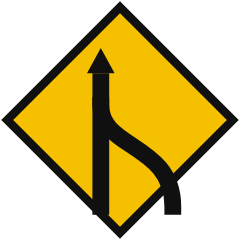
8. Why does the situation ahead of this sign deserve extra care from a motorcyclist?
Show answer
Answer C: Because a narrow machine is easy to overlook in a mirror or a blind spot
A motorcycle fills very little of a mirror and disappears easily into a blind spot, so the rider should adjust speed and lane position to stay visible where the streams come together.
-
9. How many points does Tennessee assess for driving 16 to 25 mph over the limit inside a posted work zone?
Show answer
Answer D: 5 points
The 16 to 25 mph over band inside a work zone carries 5 points, one point above the equivalent ordinary road band.
-
10. You are on a two-lane road where a broken yellow line runs on your side of the center. What does that pattern allow?
Show answer
Answer C: Passing when the way ahead is clear and it is otherwise legal
A broken yellow center line marks a stretch where passing is permitted for traffic on that side when it can be completed safely.
-
11. A motorcycle in your group develops a mechanical problem on a busy highway. What is the best response?
Show answer
Answer C: Signal the group off at the next exit or wide, safe pull off area
A narrow shoulder beside fast traffic is a dangerous place to gather, so the group moves on to a spot where every machine is well clear of the roadway.
-
12. A sign on a long descent points to a RUNAWAY TRUCK RAMP a mile ahead. What is that ramp for?
Show answer
Answer C: Stopping a vehicle whose brakes have failed
An escape ramp climbs into deep gravel or sand to bring a vehicle with failed brakes to a halt, so no one should stop or park in it.
-
13. May you park across the entrance to a fire station?
Show answer
Answer D: No, an emergency exit must never be blocked
Emergency vehicles must be able to leave the moment a call comes in, so their entrances and exits are kept clear at all hours.
-
14. May you stop in a marked bicycle lane to let a passenger out?
Show answer
Answer B: No, stopping there forces riders into the traffic lane
A vehicle stopped in a bike lane pushes riders out into moving traffic, which is exactly what the lane exists to prevent.
-
15. You are approaching the entry of a modern roundabout. Who must you yield to?
Show answer
Answer C: Traffic already circulating in the roundabout, which approaches from your left
Traffic in a United States roundabout circulates counterclockwise, so drivers entering must look left and yield to vehicles already in the circulating roadway.
-
16. What is a designated driver?
Show answer
Answer A: Someone who agrees to drink nothing at all
A designated driver drinks no alcohol whatsoever, because any amount begins to affect judgment and the whole point is a sober driver.
-
17. How should space management change with a passenger aboard?
Show answer
Answer B: Allow a greater following distance and wait for larger gaps in traffic
A loaded motorcycle accelerates and stops more slowly, so it needs more room ahead and bigger gaps to merge, to pass or to cross traffic.
-
18. You enter a work zone where the top layer of pavement has been milled off, leaving a grooved surface. How should you ride?
Show answer
Answer B: Hold a relaxed grip and steady speed, and expect the tires to wander
Milled or grooved pavement makes the tires follow the ridges and the motorcycle feel unsettled, so relax on the bars, keep a constant speed and ride straight through.
-
19. You must slow suddenly on a highway and a vehicle is following close behind you. What helps prevent a rear-end collision?
Show answer
Answer D: Tapping the brake pedal early so your brake lights flash a warning
Early brake light flashes give the driver behind more time to react, and slowing gradually instead of suddenly reduces the chance of being struck.
-
20. You have shut the engine off with the kill switch because the throttle stuck open. What comes next?
Show answer
Answer D: Keep the clutch in, brake to a stop off the road, and find the cause
With the engine off and the clutch pulled in the motorcycle is only coasting, so brake to a stop clear of traffic and inspect the throttle cable and grip before restarting.
-
21. You are following another vehicle down a long, steep grade. What should you do about the gap?
Show answer
Answer D: Make it longer, because both of you need more room to stop
Everything takes longer to stop on a downgrade, including the vehicle ahead, so the gap that works on the flat is no longer enough.
-
22. You are entering a marked work zone. What should you expect?
Show answer
Answer B: A reduced posted speed, narrowed or shifted lanes, and traffic that may stop suddenly
Work zones change the geometry of the road and can bring traffic to a halt without warning, so the posted work zone speed and increased following distance both apply.
-
23. The temperature gauge climbs toward the red while you sit in slow moving traffic. What should you do?
Show answer
Answer A: Get out of the traffic as soon as it is safe and let the engine cool
A stationary motorcycle gets almost no airflow through the engine or radiator, so the cure is to stop creeping along in traffic and let it cool.
-
24. Where should you be looking as you steer through a turn?
Show answer
Answer C: Toward the point on the new road where you want to end up
Drivers steer toward what they look at, so looking through the turn to where you want to go keeps the path smooth and accurate.
-
25. You are waiting to pull out of a driveway when a bicyclist comes along the bike lane in front of you. What must you do?
Show answer
Answer D: Wait until the bicyclist has gone past
A driver leaving a driveway yields to everything already on the road, and a bike lane is part of the roadway.
-
26. Your route crosses a long steel grid bridge deck. What should you do about braking and speed while you are on the grating?
Show answer
Answer B: Keep a steady speed and do any braking before the grating, not on it
A steel deck makes the motorcycle weave and offers less grip, so set your speed before you reach it, ride straight across, and brake on solid pavement.
-
27. Why must the handlebars be kept square during a hard straight line stop?
Show answer
Answer B: Because a front wheel turned under heavy braking can put the machine down
With the front tire loaded to its limit, any steering input asks it to do two jobs at once and the front end can wash out instantly.
-
28. You are driving at night through heavy falling snow. Which headlight setting works better and why?
Show answer
Answer C: Low beams, because high beams bounce off the falling flakes back at you
Falling snow reflects light the way fog does, so high beams build a white wall of glare while low beams still give a usable view.
-
29. A curb sign reads 2 Hour Parking, 8 AM to 6 PM, Monday to Saturday. When may you stay longer than two hours?
Show answer
Answer A: Outside those hours and on Sundays
A time limit applies only during the days and hours printed on the sign; outside them the ordinary parking rules apply.
-
30. A pedestrian using a white cane or walking with a guide dog starts to cross the street ahead of you. What must you do?
Show answer
Answer A: Yield and stay stopped until the person has finished crossing
A white cane or guide dog identifies a pedestrian who may not be able to see your vehicle, so you must yield and wait rather than maneuver around the person. The horn can confuse the pedestrian or the dog.