
Tennessee TDOSHS Motorcycle Practice Test 8
- Questions30
- Correct to pass24
- Passing score80%
- Minimum age15 years
-
1. A sign warns that your exit leaves from the left side of the freeway. What should you do?
Show answer
Answer D: Move into the left lane in good time before you reach the exit
Left-hand exits are unusual, which is exactly why they are signed well in advance and why the lane changes should be finished early.
-
2. You are traveling at the same speed as a vehicle in the next lane, just behind its rear door. What should you do?
Show answer
Answer B: Change your speed so that you leave that driver's blind spot
That position is the classic blind spot. Slow slightly or move ahead so the other driver can see you before deciding to change lanes.
-
3. Who should set the pace of a group ride?
Show answer
Answer A: The last rider in the group, so that nobody is forced to hurry to keep up
The tail ender sets the pace: every rider watches the mirrors for the rider behind, and if someone falls back the whole group slows a little to stay together.
-
4. In most states, when are headlights required apart from times of poor visibility?
Show answer
Answer A: From about half an hour after sunset to half an hour before sunrise
Most states require lights from about half an hour after sunset until about half an hour before sunrise, and some simply say sunset to sunrise; lights are also required whenever visibility is poor.
-
5. Why does the speed of the right-hand lane of a freeway change so often?
Show answer
Answer B: Vehicles entering and leaving the highway all use that lane
Entrance and exit ramps feed into the right lane, so traffic there is constantly slowing to leave or speeding up to join.
-
6. How long does Tennessee revoke a driver license after a second DUI conviction?
Show answer
Answer B: 2 years
A second DUI conviction doubles the first offense penalty, bringing a 730 day, or two year, revocation.
-
7. What is the purpose of carrying a first aid kit in your vehicle?
Show answer
Answer D: It lets you treat cuts and bleeding while the help is on its way
A kit is for simple first aid such as controlling bleeding until trained help arrives, not a substitute for calling for that help.
-
8. You make eye contact with a driver waiting to pull out of a side street. What should you assume?
Show answer
Answer D: The driver may still not have seen you, so stay ready to slow or stop
Drivers can look directly at you and still not register your vehicle, especially a small one. Eye contact helps, but never rely on it.
-
9. How should a group plan its rest stops on a long day?
Show answer
Answer A: Around the rider who tires first, with breaks before anyone is worn out
Fatigue destroys judgment long before a rider admits to it, so the break schedule follows the least rested rider rather than the strongest one.
-
10. A sign at the curb reads Tow-Away Zone. What does it mean for you?
Show answer
Answer C: That a vehicle left there can be removed at the owner's expense
In a tow-away zone the vehicle can be removed immediately and the owner pays the towing and storage charges to get it back.
-
11. A city transit bus at a stop ahead of you switches on its left signal. What should you do?
Show answer
Answer D: Slow and let the bus pull back into traffic
A bus needs a long gap to rejoin traffic, and yielding to a signaling transit bus keeps the whole line of traffic moving safely.
-
12. While you wait for the ambulance at a crash, what is the most useful help you can give?
Show answer
Answer C: Keep the person still and warm, and press down firmly on any heavy bleeding
Keeping an injured person still and warm and controlling bleeding are among the few things a bystander can safely do.
-
13. You signaled a lane change and the signal did not switch itself off afterwards. Why does that matter?
Show answer
Answer B: Other drivers may act on a turn you do not intend to make
A signal left on tells other drivers you are about to turn, and someone may pull out in front of you. Cancel it as soon as the maneuver is finished.
-
14. On an unlit road, about how far ahead do high beams normally let you see?
Show answer
Answer D: About 350 to 500 feet ahead of the vehicle
High beams light roughly 350 to 500 feet of road and low beams far less, which is why night speeds have to be chosen around the beam, not the limit.
-
15. You are very angry after an argument and about to drive. What should you know?
Show answer
Answer A: Strong emotions can impair judgment and attention much like alcohol
Anger, grief and stress pull attention inward and encourage risk taking. Give yourself time to settle down before getting behind the wheel.
-
16. You are about to slow down sharply for a turn. Which check comes first?
Show answer
Answer A: A look in the mirror to see how close the traffic behind you is
Any hard slowing needs a mirror check first, because the driver behind is the one who has to react to it.
-
17. How does a rider open the throttle to increase speed?
Show answer
Answer C: By rolling the right handgrip toward the rider
Rolling the right handgrip toward you opens the throttle, and rolling it away closes it so the engine slows.
-
18. You are turning left from a two-way street onto another two-way street. Where should you begin and end the turn?
Show answer
Answer B: Begin in the lane just right of the center line and finish just right of the center line of the new street
You approach a left turn from the lane closest to the center line and enter the new roadway just to the right of its center line, which keeps you clear of oncoming traffic.
-
19. Is a windshield an adequate substitute for eye protection?
Show answer
Answer A: No, because air and debris still reach the rider's eyes around and over the screen
Airflow passes over and around a windshield, so a face shield or goggles are still needed to keep the rider's vision clear.
-
20. Your phone is in a mount on the dashboard rather than in your hand. What is true?
Show answer
Answer B: It still takes your eyes and mind off the road
A mount solves the hand problem but not the eye or the mind problem, and reading or tapping a mounted screen costs the same seconds of attention.
-
21. You have just passed a vehicle on a two-lane road. When may you return to your lane?
Show answer
Answer B: When you can see the whole vehicle in your inside mirror
Seeing the entire vehicle you passed in your rearview mirror shows there is room to pull back in without cutting it off.
-
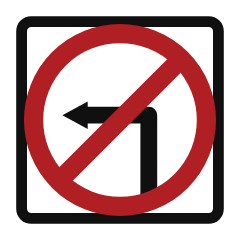
22. A driver in the leftmost lane reaches this sign at an intersection. What must the driver do?
Show answer
Answer B: Go straight on or turn right, and reach the destination another way
The restriction holds whatever the traffic or the signal is doing, so the driver has to pass the intersection and plan a different route.
-
23. A vehicle coming toward you has drifted into your lane. What should you do?
Show answer
Answer D: Slow down, sound the horn, flash your lights and steer to the right if possible
Moving right gives the other driver space to recover and keeps you out of the lane they are most likely to return to. Braking reduces the force of any impact.
-
24. Why is passing another vehicle a bad idea in dense fog?
Show answer
Answer C: You cannot see far enough ahead to know the passing lane is clear
A pass needs a clear view of the road well beyond the vehicle you are overtaking, and fog takes exactly that away.
-
25. Which clothing color is most likely to get a rider noticed in daylight?
Show answer
Answer B: Bright orange, yellow or green, which contrast with backgrounds
High visibility colors stand out against road, foliage and vehicles, which helps drivers pick a motorcycle out of a busy background during the day.
-
26. Two vehicles meet on a steep, narrow mountain road with no room to pass. Which driver should back up?
Show answer
Answer C: The driver heading downhill, who has more control while reversing
On a narrow mountain road the vehicle facing downhill yields, because backing uphill gives better control than reversing down a grade.
-
27. Why should pant legs be secured and bootlaces tucked away?
Show answer
Answer A: Loose fabric and laces can tangle in the chain, the controls or a wheel
Anything hanging near the moving parts of a motorcycle can be caught and pulled in, which can trap a foot or lock the rear wheel.
-
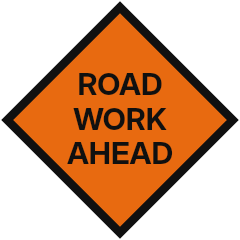
28. This sign is still standing late at night, and nobody is working. What should the driver assume?
Show answer
Answer B: The layout may still be altered, so the same care and reduced speed apply
Narrowed lanes, shifted alignments, dropped pavement edges and parked equipment remain overnight, so the hazard does not end when the crew goes home.
-
29. Why is an underinflated tire especially risky on a long drive in hot weather?
Show answer
Answer C: It flexes more, builds up heat and can fail at speed
A soft tire flexes on every rotation, and that flexing makes heat that the hot road and high speed add to until the tire can come apart.
-
30. Why is hard braking the wrong response to a tire blowout at speed?
Show answer
Answer C: Because it can pull the vehicle further out of line and start it spinning
With one tire gone the braking forces are uneven, so heavy braking increases the pull to one side and can spin the vehicle.