
Tennessee TDOSHS Motorcycle Practice Test 1
Test 1 of 6. Pick an answer for each question to see if it is right and why; your score appears at the end. You need 24 correct answers to pass, the same ratio as the real Tennessee test.

- Questions30
- Correct to pass24
- Passing score80%
- Minimum age15 years
-
1. What minimum fine does Tennessee law set for a speeding violation committed inside a posted highway work zone?
Show answer
Answer B: 250 dollars
Tennessee sets a 250 dollar minimum fine for violations inside a posted construction or work zone, well above ordinary roadway penalties.
-
2. A sign at the curb reads Tow-Away Zone. What does it mean for you?
Show answer
Answer C: That a vehicle left there can be removed at the owner's expense
In a tow-away zone the vehicle can be removed immediately and the owner pays the towing and storage charges to get it back.
-
3. A pedestrian signal changes to a flashing upraised hand. What does that indication mean?
Show answer
Answer C: Do not start crossing, but finish a crossing already begun
The flashing upraised hand is the pedestrian change interval: nobody may start to cross, but a pedestrian already in the crosswalk may continue to the far side or to a median.
-
4. A Tennessee driver's SR-22 policy is cancelled before the requirement is finished. What happens next?
Show answer
Answer D: The driver's driving privileges are suspended, and the SR-22 and reinstatement fees must be redone
An early lapse in SR-22 coverage leads to a suspension for failing to maintain proof of financial responsibility, forcing the driver to refile SR-22 and pay reinstatement fees.
-
5. A piece of farm machinery ahead of you is wider than its own lane. What should you do?
Show answer
Answer C: Hold back until you can see far enough to pass safely
Wide equipment leaves no gap inside the lane and may use part of the other side, so a pass needs a long clear view of the road ahead.
-
6. How many points does Tennessee assess for driving 46 mph or more over the posted limit?
Show answer
Answer B: 8 points
The top speeding band, 46 mph or more over the limit, carries the maximum 8 points on the Tennessee schedule.
-
7. Why is wearing headphones over both ears a problem while driving?
Show answer
Answer D: You may not hear horns, sirens or other warning sounds
Hearing is part of your awareness of traffic. Covering both ears blocks emergency sirens, horns and the sound of an approaching vehicle you cannot yet see.
-
8. You are stopped at an intersection where bushes block your view of cross traffic. What should you do?
Show answer
Answer A: Edge forward slowly until you can see, then proceed when clear
Creeping forward a little at a time lets you gain a view without committing to the crossing. Never enter an intersection you cannot see into.
-
9. You are the second vehicle waiting to turn left on a green ball. Where should you wait?
Show answer
Answer A: Behind the stop line, until the first vehicle has actually turned
Only the lead vehicle should move into the intersection to wait; a second vehicle inside it is likely to be stranded there when the light changes.
-
10. What does a yield sign require of a driver?
Show answer
Answer A: Slow down, and stop when necessary, so conflicting traffic can go first
A yield sign obliges the driver to reduce to a speed suited to conditions and to stop when needed so that conflicting traffic or pedestrians are not interfered with.
-
11. Under the Tennessee Move Over Law, what must you do on a multi-lane road when you approach a stationary emergency vehicle with its lights flashing?
Show answer
Answer B: Change into a lane not next to the vehicle, or slow to a safe speed if you cannot
The law asks for a lane change away from the stopped vehicle whenever it is safe, and a reduced, safe speed when moving over is not possible.
-
12. The leader gives a hand signal that you can see clearly from your place in the group. What should you do with it?
Show answer
Answer A: Repeat the signal so the riders behind you also receive it
Signals are passed down the line rider by rider, because riders further back cannot see the leader through the machines in between.
-
13. What does a flashing yellow traffic light mean?
Show answer
Answer B: Slow down and proceed with caution
A flashing yellow lets you enter the intersection cautiously after yielding to pedestrians and to conflicting traffic that is already there.
-
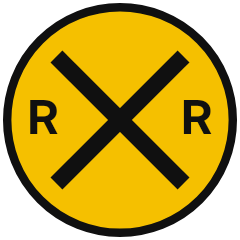
14. Where is this sign installed in relation to the hazard it announces?
Show answer
Answer A: Far enough before the hazard that a driver can slow down and stop short of it
This is an advance warning sign, placed on the approach so a driver has time to react before reaching a crossing that a curve or a crest may be hiding.
-
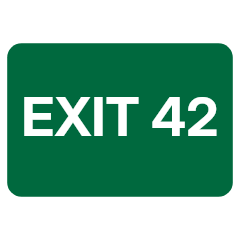
15. Where is signing of this kind normally placed along a freeway?
Show answer
Answer D: Ahead of the interchange and again at the exit, so a driver can reach the correct lane in time
Guide information for an interchange is repeated on the approach and at the ramp, because a driver who learns about the exit only at the last moment has no room left for a safe lane change.
-
16. A 15 year old holds a restricted Tennessee Class M-Limited license for a small motor driven cycle. What restriction applies?
Show answer
Answer A: Riding only between 4 a.m. and 8 p.m., within a 7 mile radius of home
Just like the Class P-M permit, the restricted Class M-Limited license issued to a 15 year old limits riding to the 4 a.m. to 8 p.m. window and a 7 mile radius of home.
-
17. About how far does a vehicle travel in one second at 60 mph?
Show answer
Answer A: About 88 feet
At 60 mph you cover about 88 feet every second, which is why a glance of only two or three seconds means driving the length of several vehicles blind.
-
18. Your road ends at a T-intersection with no signs or signals. Who has the right-of-way?
Show answer
Answer A: Traffic on the through road, and you must yield before entering
A driver on a road that ends at a T-intersection must yield to traffic on the through road that continues past the junction.
-
19. How many points does Tennessee assess for failing to stop at a railroad crossing when required?
Show answer
Answer D: 8 points
Failing to stop at a railroad crossing sits at the top of the schedule with 8 points, the same weight as the most serious violations listed.
-
20. How many points does Tennessee assess for driving 6 to 15 mph over the limit inside a posted work zone?
Show answer
Answer C: 4 points
Driving 6 to 15 mph over the limit in a work zone carries 4 points, matching the ordinary road penalty for the next band up, 16 to 25 mph over.
-
21. A friend who has been drinking insists on driving home. What is the right thing to do?
Show answer
Answer B: Take the keys and arrange a sober ride, even if the friend objects
An impaired driver is dangerous on any street at any speed, and coffee does not lower blood alcohol. Keeping the keys and finding another way home is the only safe choice.
-
22. A Tennessee driver is convicted of illegal racing on a public road. What insurance consequence follows?
Show answer
Answer A: The driver must file SR-22 proof of financial responsibility
A racing or speed competition conviction is among the offenses that require the driver to carry SR-22 coverage.
-
23. On a long, straight highway you feel your attention fading. What helps you stay alert?
Show answer
Answer A: Keep your eyes moving, scan mirrors and signs, and take regular breaks
Staring at one point brings on highway hypnosis. Active scanning keeps the mind engaged, and a break every couple of hours restores alertness.
-
24. Some toll facilities use signs and markings with a purple background or a purple stripe. What do they identify?
Show answer
Answer D: Lanes reserved for vehicles with an electronic toll account
Purple is assigned to lanes and ramps restricted to vehicles with a registered electronic toll collection account, so drivers without one must stay out.
-
25. How many points does a non-commercial Tennessee driver receive for a handheld device violation, separate from the under-18 cell phone charge?
Show answer
Answer B: 3 points
The general handheld device violation for a non-commercial driver carries 3 points, the same value given to texting while driving.
-
26. What testing benefit does a Tennessee Motorcycle Rider Education Program certificate give to someone who already holds a valid Tennessee driver license?
Show answer
Answer A: It waives both the motorcycle knowledge test and the on-cycle skills test
A Tennessee certified rider education certificate exempts a holder of a valid Tennessee driver license from both the motorcycle knowledge test and the skills test, whereas a Motorcycle Safety Foundation course taken elsewhere waives only the skills test.
-
27. Under the Tennessee implied consent law, what normally happens if an arrested driver refuses the chemical test?
Show answer
Answer B: The court suspends driving privileges for twelve months
Driving in Tennessee implies consent to alcohol or drug testing, and a refusal after arrest normally leads the court to suspend driving privileges for twelve months.
-
28. Every signal head at an intersection is flashing red in all directions. How should you treat the intersection?
Show answer
Answer C: As an all-way stop, stopping and then going in turn
Red flashing in every direction means each approach must stop, so the intersection works exactly like an all-way stop.
-
29. A Tennessee driver is found to have contributed to a crash that resulted in another person's death. How many points does the schedule assess?
Show answer
Answer C: 8 points
Contributing to a fatal crash is assessed at the maximum 8 points, the same weight given to the schedule's most serious violations.
-
30. For how long must a Tennessee driver required to file SR-22 keep that coverage in place?
Show answer
Answer D: For the full length of the driver's suspension or revocation period
SR-22 coverage must stay in force for the entire suspension or revocation period tied to the offense that triggered it, whether the driver holds a restricted license or has been fully reinstated.