
Tennessee TDOSHS Permit Practice Test 9
Test 9 of 10. Pick an answer for each question to see if it is right and why; your score appears at the end. You need 24 correct answers to pass, the same ratio as the real Tennessee test.

- Questions30
- Correct to pass24
- Passing score80%
- Minimum age15 years
-
1. Since 2017, how does Tennessee confirm that registered vehicles carry the required liability insurance?
Show answer
Answer D: Through a web based electronic verification system under the James Lee Atwood Jr. Law
Since 2017 Tennessee has used a web based program, established under the James Lee Atwood Jr. Law, to electronically verify insurance coverage for registered vehicles.
-
2. Why is a sign reading BRIDGE ICES BEFORE ROAD worth heeding even when the road itself is merely wet?
Show answer
Answer C: Cold air passes under a bridge as well as over it
A bridge deck loses heat from below as well as above, so it can be frozen while the road on either side of it is only wet.
-
3. You leave your car so that its rear overhangs a marked crosswalk. What is wrong with that?
Show answer
Answer B: Pedestrians must step around it into the traffic lane
A crosswalk has to stay completely clear; anything sticking into it pushes people on foot out into the path of moving vehicles.
-
4. Compared with dry pavement, how much room does a vehicle need to stop on packed snow?
Show answer
Answer D: Several times as much
Grip on packed snow is a fraction of that on dry pavement, so stopping distance grows several times over. Antilock brakes help you steer, not stop shorter.
-
5. Besides registering at a Driver Services Center, where else can a Tennessean sign up as an organ and tissue donor?
Show answer
Answer D: DonateLifeTN.org
Tennesseans can register as organ and tissue donors directly through DonateLifeTN.org, in addition to registering at a Driver Services Center.
-
6. How many points does Tennessee assess for following another vehicle too closely, listed as following improperly?
Show answer
Answer A: 3 points
Following improperly, the schedule's term for tailgating, is worth 3 points.
-
7. A teen applying for a Tennessee learner permit currently holds a suspended license from another state. What does this do to the Tennessee application?
Show answer
Answer B: It makes the teen ineligible for the graduated program until that status is resolved
Tennessee treats a suspension or revocation in any state, along with habitual offender status, as a disqualifying factor for the graduated licensing program.
-
8. You are stopped in a shared through and right-turn lane with your right signal on, and a bicyclist rides up along your right side. What should you do?
Show answer
Answer A: Let the bicyclist clear the intersection or move ahead before you turn
A cyclist alongside your right side is in the path your turn will sweep across, so wait until that space is clear before turning.
-
9. How does the one year Tennessee learner permit fee differ between an applicant who is 18 or older and one who is under 18?
Show answer
Answer C: 18 and older pays 5.50 dollars; under 18 pays 10.50 dollars
An adult applicant for the learner permit pays 5.50 dollars, while an applicant under 18 pays the higher 10.50 dollar rate, both for one year of validity.
-
10. How long must a Tennessee Level I learner permit be held before the holder can move up to an Intermediate Restricted License?
Show answer
Answer C: At least 180 days
Tennessee requires the learner permit to be held for a minimum of 180 days before the teen can advance to the next stage.
-
11. How many points does Tennessee assess for driving 16 to 25 mph over the limit inside a posted work zone?
Show answer
Answer D: 5 points
The 16 to 25 mph over band inside a work zone carries 5 points, one point above the equivalent ordinary road band.
-
12. You want to move into the right lane just as an entrance ramp joins the highway at that point. What is the better choice?
Show answer
Answer B: Wait until you are past the merge area so you do not squeeze the entering traffic
The merge area is where ramp traffic has to find a gap, so adding a lane change of your own into the same space creates a conflict.
-
13. While you are still on an entrance ramp, where should your attention be?
Show answer
Answer D: Along the ramp ahead and back at the highway traffic in the mirrors and over your shoulder
A merge needs both halves of the picture at once: the ramp curving ahead of you and the traffic you are about to join behind and to your left.
-
14. On an overhead guide sign, the small exit number panel sits above the left-hand end rather than the right. What does that placement tell you?
Show answer
Answer A: The exit leaves from the left side of the roadway
The exit number plaque is placed on the side from which the ramp leaves, which gives advance notice of the unusual left-hand exit.
-
15. The vehicle you want to pass is traveling close to the speed limit. What should you do?
Show answer
Answer C: Stay behind, because a pass may not take you over the limit
The speed limit applies while passing too. If you cannot complete the pass without exceeding it, do not start the pass.
-
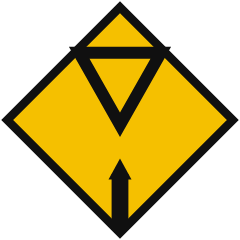
16. What will the driver have to do at the point this sign refers to?
Show answer
Answer C: Slow down and let conflicting traffic go first, stopping if that is what it takes
Further along, the driver has to let conflicting traffic and pedestrians go first, reducing speed and stopping whenever that is necessary to avoid interfering with them.
-
17. You are stopped at an intersection where bushes block your view of cross traffic. What should you do?
Show answer
Answer A: Edge forward slowly until you can see, then proceed when clear
Creeping forward a little at a time lets you gain a view without committing to the crossing. Never enter an intersection you cannot see into.
-
18. A center lane is marked with a broken yellow line on each side and is controlled by overhead lane signals. How is that lane used?
Show answer
Answer A: It carries traffic one way or the other according to the signals
A reversible lane is marked with broken yellow lines on both sides and its direction of travel is set by the lane control signals above it.
-
19. How long is a Tennessee driver license revoked after a first DUI conviction, triggering the ignition interlock requirement?
Show answer
Answer B: 1 year
A first DUI conviction brings a 365 day, or one year, revocation, and the interlock is required for that entire period if the driver wants to keep driving.
-
20. You have finished parallel parking at the curb. How should the vehicle sit?
Show answer
Answer A: Close to the curb, so that it does not stick out into the traffic lane
A parked vehicle must sit close enough to the curb that it does not intrude into the path of passing traffic; the exact maximum distance is set by each state.
-
21. What penalties does Tennessee attach to an underage driving while impaired conviction?
Show answer
Answer C: Loss of the license for one year and a 250 dollar fine
The conviction costs the young driver the license for one year plus a 250 dollar fine, and public service work is sometimes added.
-
22. How many points does Tennessee assess for driving 6 to 15 mph over the limit inside a posted work zone?
Show answer
Answer C: 4 points
Driving 6 to 15 mph over the limit in a work zone carries 4 points, matching the ordinary road penalty for the next band up, 16 to 25 mph over.
-
23. Your vehicle has stalled on railroad tracks and no train is in sight. After getting everyone away, whom should you call first?
Show answer
Answer B: The railroad emergency number posted on the blue sign at the crossing, giving the crossing number
Every public crossing has a blue emergency notification sign with a phone number and a crossing identification number. That call lets the railroad stop or slow trains before they reach you.
-
24. A yellow sign shows a truck on a slope with the legend 7 PERCENT GRADE. What should a driver of a heavy vehicle do?
Show answer
Answer A: Select a lower gear before starting down
The percentage shows how steep the descent is, and choosing a low gear at the top lets the engine hold the vehicle back instead of the brakes overheating.
-
25. Two vehicles reach a four-way stop at the same moment from adjacent roads. Who should go first?
Show answer
Answer A: The driver on the right
When two drivers stop at a four-way stop at the same time, the driver on the left yields to the driver on the right.
-
26. A driver ahead brakes for no reason you can see, again and again. What should you do?
Show answer
Answer B: Increase your following distance and be ready for yet another stop
Unexplained braking tells you the driver is unsure or distracted, so the safe answer is more room, not less.
-
27. How many points does Tennessee assess for failing to yield the right-of-way?
Show answer
Answer D: 4 points
Failing to yield the right-of-way is another 4 point violation on the Tennessee schedule.
-
28. How should your following distance change in heavy rain?
Show answer
Answer D: It should be increased well beyond what you use on dry pavement
Wet pavement lengthens stopping distance and rain cuts visibility at the same time, so a larger gap gives you the extra seconds needed to see a problem and stop for it.
-
29. Rain is heavy enough that you have your windshield wipers running. What else should you switch on?
Show answer
Answer A: Your headlights, so you can see and others can see you
Rain heavy enough to need wipers also cuts how far away you can be seen, so the headlights belong on. Many states write this into law as a wipers on, lights on rule.
-
30. Why does safety guidance say a child should ride in the back seat rather than in front of an active passenger airbag?
Show answer
Answer D: Because the airbag inflates with enough force to injure a small child badly
Airbags deploy at very high speed and are sized for adults, so a child seated close to one can be badly hurt by the bag itself, which is why the back seat is recommended for children.